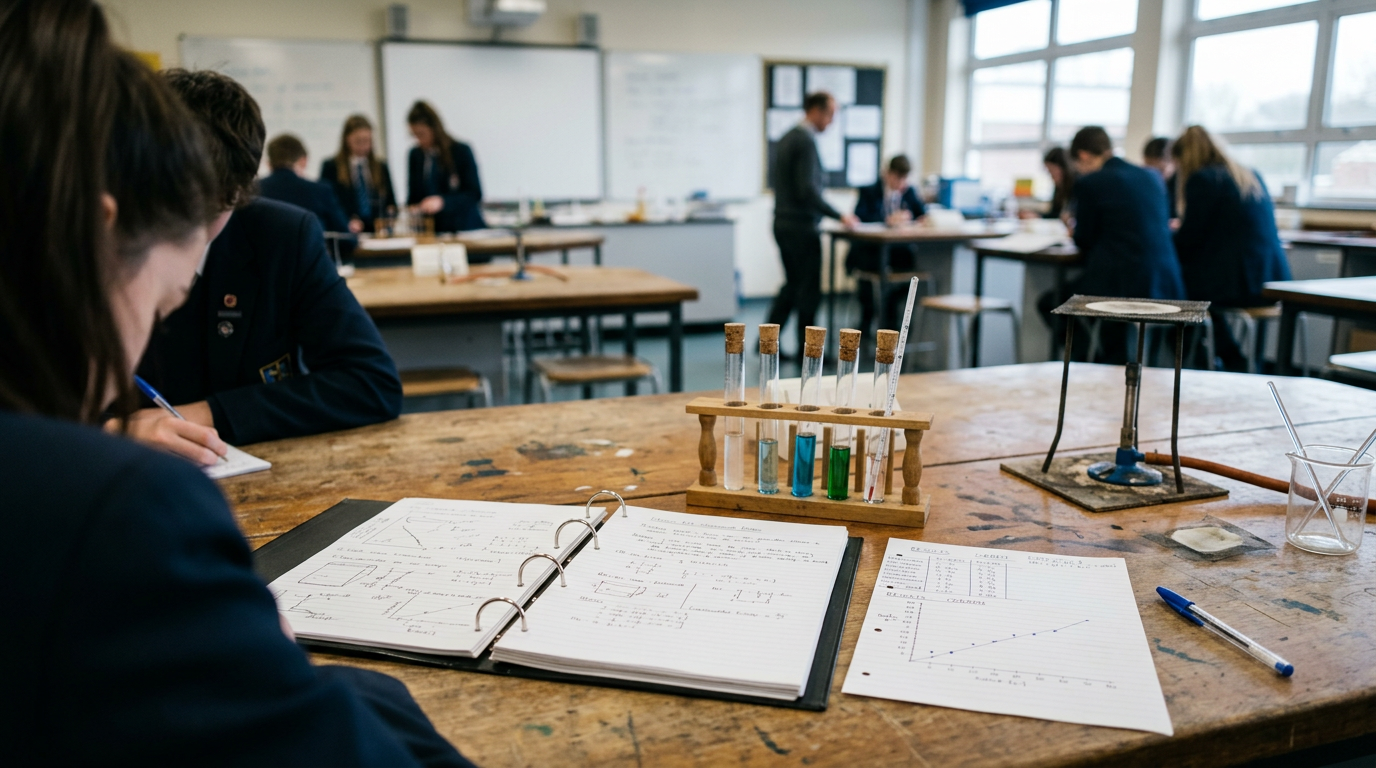
There is no single answer because there is no single thing. Fieldwork-based coursework in geography or psychology already contains original data and converts most easily. Source-based essays in history or English are literature reviews and need a venue that accepts those. The common gap in all of them is a methods section and a sample large enough to support the claim.
Students ask this as one question. It is at least four, because "A-level coursework" covers things with almost nothing in common.
What kind of coursework do you actually have?
This determines everything that follows.
| Type | Typical subjects | Contains original data? | Realistic route |
|---|---|---|---|
| Fieldwork investigation | Geography, Environmental Science | Yes | Scale the sample, then original-research venues |
| Empirical investigation | Psychology, Sociology, PE | Usually | Scale or move to public microdata |
| Build-and-evaluate project | Computing, Design, Engineering | Yes | Often converts with least work |
| Source-based essay | History, English, Classics, Politics | No | Venues that accept literature reviews |
| Practical portfolio | Art, Music, Drama | N/A | Not a journal route |
If you are in the bottom two rows, most of what follows about scaling does not apply to you — skip to the literature-review section.
If your coursework has original data
You are closer than almost any other school qualification, and the obstacle is probably sample size.
A geography fieldwork study along one transect with thirty measurements is a genuinely good piece of school work. It is also a sample a reviewer will not accept as supporting a general claim, because thirty points on one river on one day could be almost anything.
Three ways out, in order of effort:
Scale your own data. More sites, more days, more measurements. This is the purest route and the slowest.
Add a public dataset as a comparison. Your transect becomes a case within a larger pattern drawn from, say, Environment Agency or DEFRA records. Our list of free datasets covers twenty-two sources, several of them environmental.
Reframe as a methods study. Sometimes the interesting finding is not your result but how sensitive it was to your technique. "How much does measured channel width vary with operator choice?" is a real question answerable from a small sample, because the small sample is the subject.
For psychology, the equivalent move is usually abandoning your own participants and taking the same question to a national survey — Monitoring the Future, the General Social Survey, the UK Data Service — where the sample is already in the thousands.
If your coursework is a source-based essay
It is a literature review. That is not a problem, provided you send it to the right place.
The commonest avoidable rejection in student publishing is a review submitted to a journal that publishes original research only. Think.Check.Submit. is the checklist to run before committing to any venue. Vanderbilt's Young Scientist Journal states it plainly — "Original research only, no review articles will be accepted" — and the Journal of Emerging Investigators wants a finding.
The venues that do accept reviews are NHSJS, the Columbia Junior Science Journal and the Oxford Journal of Student Scholarship, which accepts "Original Research Articles and Literature Reviews" and asks for 2,000 to 8,000 words.
What a history or English essay usually needs before it goes anywhere:
- A stated selection method. Which sources, chosen how, and what you left out. An A-level essay is not required to say; a review article is.
- An argument about the literature, not just within it. A review's contribution is a claim about the state of the debate.
- Scope widened slightly. Coursework questions are often narrower than a journal wants, because they were sized to a word limit and a mark scheme.
Our guide on how to write a literature review covers the shape.
What every conversion needs
Three things, whichever branch you are on.
A methods section somebody could repeat. This is the section student submissions are weakest on and the section reviewers read first. Not "I collected data at three sites" but which sites, chosen on what basis, measured how, with what excluded and why.
The assessment scaffolding removed. Anything written for a marker rather than a reader — explicit signposting to criteria, reflective passages, evaluation sections that exist because a rubric required one.
A conclusion sized to the evidence. The joint COPE, DOAJ, OASPA and WAME principles govern how venues should behave; naming your own limits is the author-side equivalent. Every capable student's first draft over-asserts. You found a correlation in a small sample; say so, name what you could not control for, and state what would be needed to go further. Reviewers trust a paper that names its own weaknesses.
The timing problem
Wait until your A-level assessment is complete, and check your school's position first.
Coursework sits inside a live assessment process with its own authentication and malpractice rules. Publishing it before that concludes creates a category of problem with no upside whatsoever, and the cost of waiting is a few months.
Is it worth it?
The honest answer is the same as for the EPQ, the IB Internal Assessment and the Advanced Higher project: it depends whether the question still interests you.
Convert it if the coursework raised something you still want answered, and the scale or the word limit stopped you. That student will enjoy the work and finish it.
Start fresh if the motivation is mainly to have a publication. The conversion effort — new data, new methods section, restructured argument — is comparable to a new project. You may as well spend it on a question you chose for its own sake.
And keep the stakes in proportion. Caltech reports 42% of admitted students submitted research and routes independent work to a portfolio; Yale asks applicants to state "your specific contributions if the work was done in collaboration with others." Beyond those, almost no university publishes a position on what a student publication is worth. A piece of work you can defend under twenty minutes of questioning holds up either way.
Where we fit
The Oxford Centre for Advanced Research pairs students with PhD candidates and early-career researchers at Oxford, Cambridge, other leading UK universities and Ivy League institutions. The Oxford Publication Fellowship is £3,400, roughly $4,400, and is built around getting a project to submission standard.
We submit to the Oxford Journal of Student Scholarship, the Journal of Research High School and Vanderbilt's Young Scientist Journal, through standard review. All three reject student work, ours included.
Most A-level conversions we see become new projects within three sessions, because the honest read on the original sample is that it will not carry the claim. We would rather say that at the start than four months in.
The test before you start
Look at your sample and ask whether you would believe your own conclusion if a stranger showed it to you.
If yes, convert. If no, the project needs data, not editing — and knowing which of those you are facing is most of the decision.
Frequently asked questions
Can A-level coursework be published?
Some of it, with work. The determining factor is whether your coursework produced original data. Geography fieldwork and psychology investigations usually did. History and English essays did not — they are literature reviews, which is a perfectly publishable thing at the venues that accept them.
Which subject's coursework converts best?
Geography fieldwork, because it already has a method, a sample and original measurements. Psychology investigations are second, though sample size is usually the obstacle. Computing projects often convert with almost no work because the artefact and the evaluation already exist.
What is the biggest obstacle?
Sample size, in the empirical subjects. A geography fieldwork study with thirty measurements along one transect, or a psychology investigation with twenty classmates, will not support a claim a reviewer accepts. That is fixed by collecting more data or by moving to a larger public dataset, not by rewriting.
Can I submit it while I am still being assessed?
No. Wait until your A-level assessment is complete, and check your school's academic honesty position first. Publishing coursework still inside the assessment cycle creates problems that are entirely avoidable by waiting a few months, and there is no deadline that justifies the risk.
Where would a history or English essay go?
To a venue that accepts literature reviews: NHSJS, the Columbia Junior Science Journal or the Oxford Journal of Student Scholarship. Sending a source-based essay to a journal that publishes original research only is the commonest avoidable rejection in student publishing.
Is it worth it, or should I start fresh?
Convert if the coursework raised a question you still want answered and the scale frustrated you. Start fresh if you mainly want a publication — the conversion effort is comparable to a new project, so you may as well pick a question you chose for its own sake rather than one a mark scheme shaped.