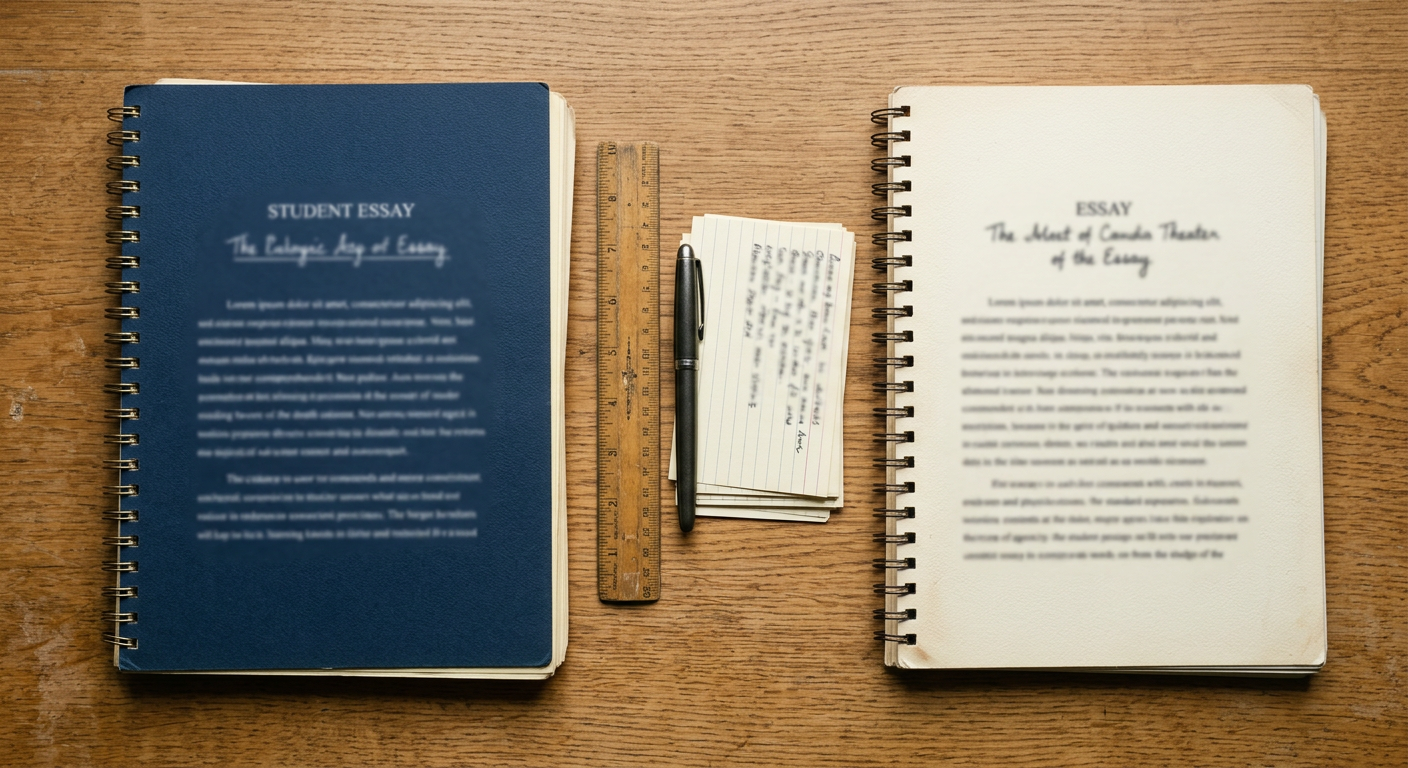
The EPQ is subject-agnostic, around 5,000 words, can be a product rather than an essay, and is a standalone qualification worth UCAS points. The Extended Essay sits inside one IB subject, is capped at 4,000 words and is marked against that subject's criteria. The EPQ gives more freedom; the EE gives more discipline — and that difference should change how you pick a question.
Almost nobody actually chooses between these. If you are doing A-levels you may have the EPQ available; if you are doing the IB Diploma the Extended Essay is compulsory. The reason to understand the difference is that it changes how you should pick a question.
The differences that matter
| EPQ | IB Extended Essay | |
|---|---|---|
| Who does it | A-level students, optional | IB Diploma students, compulsory |
| Subject tie | None — any topic | Must sit inside one DP subject |
| Length | ~5,000 words (dissertation route) | 4,000 words, capped |
| Format | Essay or artefact plus report | Essay only |
| Marked against | Project skills, subject-agnostic | That subject's own criteria |
| Counts toward | Standalone qualification, UCAS points | The Diploma core |
| Supervision | A supervisor, loosely defined | Assigned supervisor, formal reflection sessions |
Two of these rows do most of the work.
The subject tie. An Extended Essay in psychology is marked by psychologists against psychology's criteria. A brilliant question answered with the wrong discipline's methods scores badly. The EPQ has no such constraint — it assesses the process rather than the disciplinary fit.
The artefact option. The EPQ can be a thing you made, with a written report alongside it. A piece of software, a composition, a designed object, a performance. This is its most underused feature and the reason an EPQ can suit a student who does not want to write 5,000 words.
What each one is actually assessing
The EPQ assesses the research process. AQA allocates 20% of the marks to AO2, defined as "research, critically select, organise and use information." The operative phrase is critically select — you are assessed on choosing between sources that disagree. A question answerable from one textbook cannot earn those marks however well written.
The Extended Essay assesses whether you can do a small piece of work in a discipline the way that discipline does it, and it requires formal reflection sessions with your supervisor recorded as you go. The reflection is assessed, which surprises students who treat it as paperwork.
The practical upshot for both: your question should force you to adjudicate a disagreement. That is what both mark schemes reward, by different routes.
Which is harder?
They fail in opposite directions.
The Extended Essay is harder to scope. Four thousand words, one subject, one set of methods. Students who pick a question that would need six thousand words discover it in January, and cutting is more painful than planning.
The EPQ is harder to start. Nothing constrains it. Any topic, any format, five thousand words or an artefact. That freedom is why EPQ students are disproportionately the ones still reading in February without a question — there is no external structure forcing a decision.
If you are doing the EPQ, impose the constraint yourself in week one: pick the subject you would have had to pick under the IB, and work inside it.
Which do universities prefer?
Neither as a category, and the honest answer has one concrete asymmetry.
Some UK universities make reduced offers on the strength of a good EPQ grade. That is a real, published advantage with no Extended Essay equivalent in the UK system. On the other side, the Extended Essay is a compulsory component of a Diploma those same universities recognise and value as a whole.
Beyond that, almost nothing is published about how either is weighted. What does hold up is the interview mechanism: a tutor can question you about your project for as long as they like. A project you can defend for twenty minutes is worth more than the label on it, and a project someone else effectively shaped is actively dangerous — Yale asks applicants to state "your specific contributions if the work was done in collaboration with others."
Our piece on whether research programmes are worth it in the UK goes into what UK universities actually say, which is less than the market implies.
How the question-choosing differs
Same test, different constraints.
The test is the same for both: can you say in one sentence what evidence would change your answer? "Is social media harmful to teenagers" fails. "Does reported screen time predict reported sleep duration among US 12th graders in the 2023 Monitoring the Future survey, controlling for sex and region" passes.
What differs is what you do next.
For the Extended Essay: check your question is answerable using your chosen subject's methods, and that it fits 4,000 words. If the literature review alone would take 1,500, narrow further. Our thirty worked EE questions are grouped by DP subject group for exactly this reason.
For the EPQ: pick your constraint before you pick your question. Decide which discipline you are working in and which dataset you will use, then let the question come out of that. Thirty EPQ questions and our list of free datasets are the starting points.
Either way, how to build a question worth publishing is the method underneath both.
Can either be published?
Usually not as written, and that is worth knowing in September rather than March.
Research journals want original findings and a paper structure — introduction, methods, results, discussion. Both the EPQ and the EE are extended arguments with reflective components attached. Converting either means narrowing the question, adding a proper methods section and cutting the reflection: real work, not reformatting.
Two practical notes. If publication is a goal, pick a question with a dataset behind it rather than a purely argumentative one, and pick it now. And check the venue's scope: NHSJS and the Columbia Junior Science Journal accept literature reviews, which most student journals do not, so a synthesis-shaped project has somewhere to go.
Where we fit
The Oxford Centre for Advanced Research pairs students with PhD candidates and early-career researchers at Oxford, Cambridge, other leading UK universities and Ivy League institutions. The Oxford Scholar Programme is £2,000 — about $2,600 — for ten contact hours over ten to fourteen weeks; the Oxford Publication Fellowship is £3,400, roughly $4,400.
Both qualifications come with a supervisor built in, and for most students that supervisor plus a teacher with a doctorate is enough. If you are weighing paying us against doing your EPQ or EE properly, do the qualification properly — it is free, it is on your timetable, and it is the same skill.
The one difference to act on
If you are doing the EPQ, borrow the IB's constraint: pick one subject and stay inside it.
If you are doing the Extended Essay, borrow the EPQ's: ask what you would make if you were not required to write an essay, because the answer usually reveals what you actually want to find out.
Frequently asked questions
Can you do both?
Rarely, and usually not worth it. The EPQ sits with A-levels and the Extended Essay is a compulsory part of the IB Diploma, so very few students are in a position to do both. If you are, do one properly rather than two adequately — a strong single project beats two thin ones at interview.
Which is harder?
Different hard. The Extended Essay is harder to scope because it must be answerable using one subject's methods and capped at 4,000 words. The EPQ is harder to start because nothing constrains it — total freedom is the commonest reason EPQ students are still reading in February.
Which do universities prefer?
Neither, as a category. Some UK universities make reduced offers for a strong EPQ grade, which is a concrete advantage the EE does not have in the UK system. But the EE is a compulsory component of a Diploma those same universities recognise. The project you can discuss well is worth more than the label.
Does the EPQ have to be an essay?
No, and this is its most underused feature. It can be an artefact — a piece of software, a performance, a designed object, a piece of original composition — accompanied by a written report. The Extended Essay cannot: it is an essay by definition.
How long is each?
The EPQ written report is around 5,000 words for a dissertation-style project, less where there is an artefact. The Extended Essay is capped at 4,000 words and examiners stop reading at the limit, which makes the cap a genuine design constraint rather than a guideline.
Can either be published?
Usually not as written. Both are extended arguments with reflective components; research journals want original findings and a methods section. Converting either means narrowing the question, adding methods and cutting the reflection. Choose a question with a dataset behind it now if publication is a goal.