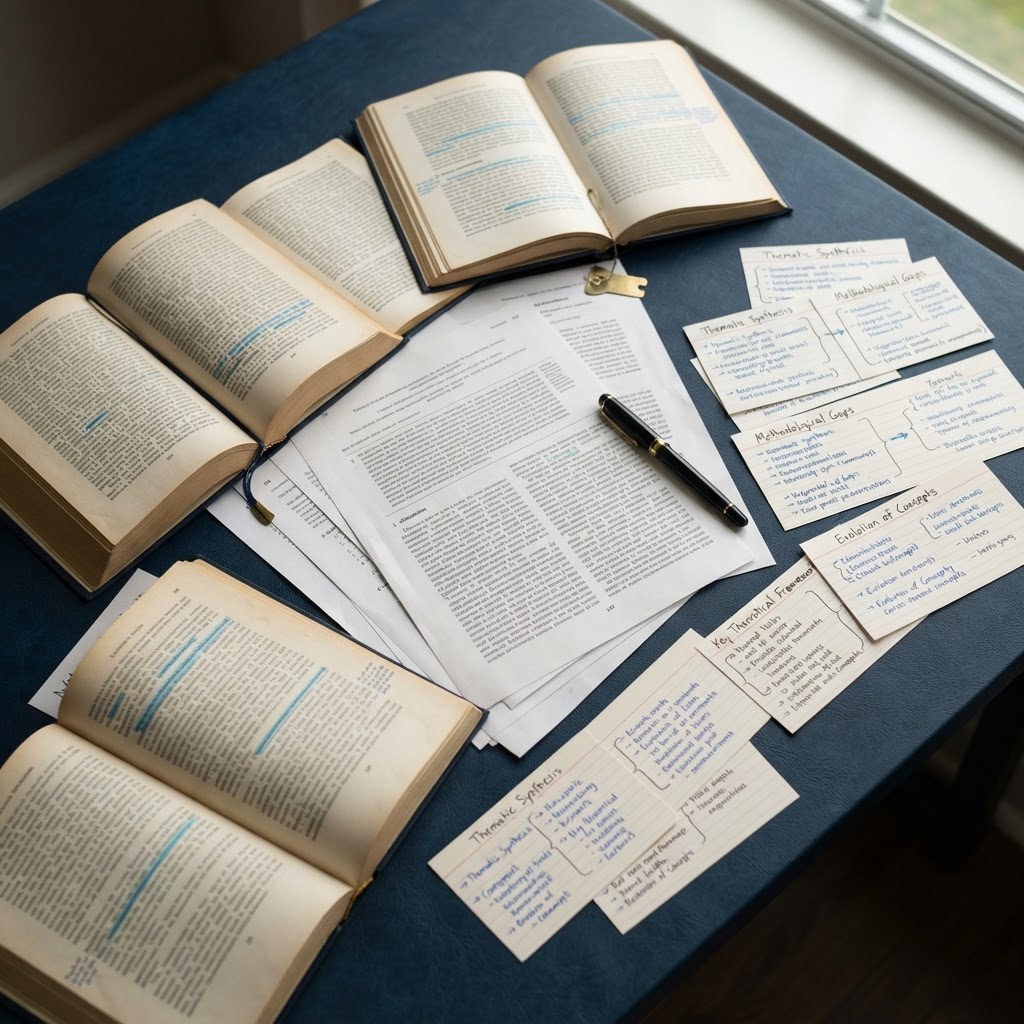
A literature review is "an account of the current thinking in a specific area of study" — not a list of what you read. The University of Sheffield's guidance is that you should "include only the most relevant, important or influential sources" and "identify gaps or limitations in existing research." Six well-chosen sources arranged by argument beats twenty arranged by author, and the difference is the one thing examiners and reviewers both look for.
Most sixth-form literature reviews are book reports in disguise.
They go: Smith said this. Jones said that. Patel said something else. In conclusion, more research is needed. Every source gets its own paragraph, the paragraphs sit in the order the student read them, and nothing connects.
That structure is the single most common weakness in EPQs, Extended Essays and student journal submissions, and it is fixable in an afternoon once you see what the section is actually for.
What is a literature review for?
Two jobs, and neither is showing that you did the reading.
The University of Sheffield defines it as "an account of the current thinking in a specific area of study", and lists what it should do: introduce the reader to the area, organise sources thematically "starting with the more general, broader themes and narrowing towards the most specific," introduce the key theories, define important terms, and — the crucial one — "identify gaps or limitations in existing research."
So the two jobs are:
Orient the reader. Someone who does not know your field should finish the section understanding what the main positions are and why they disagree.
Justify your question. The gap you identify is the reason your project exists. A good literature review ends with the reader thinking "somebody should check that" a paragraph before you say you checked it.
That second job is what makes it a literature review rather than an essay about books. If your question could be removed and the section would read the same, it is not doing its job.
How do you find the sources?
Three routes, and one technique that does most of the work.
Google Scholar for almost everything. Search your topic, read abstracts, follow what looks relevant.
Preprint servers — arXiv, bioRxiv, medRxiv, SSRN — which are free and complete rather than paywalled. For physics, maths, computer science, biology and the social sciences, you can read entire papers.
Your school or local library's database access, which often includes JSTOR and more than students assume. Ask the librarian; they are usually delighted that someone did.
The technique that matters most is snowballing. Reading's library guide recommends that you "check reference lists and citation indexes to see which texts are frequently cited". Find one genuinely relevant paper, mine its reference list for what it builds on, then use Google Scholar's "cited by" to find what came after it. Two or three rounds of that maps a small field faster than any amount of keyword searching.
Reading's guide also suggests starting with about three key texts per topic, then identifying gaps and reading further to fill them. That is a far more efficient order than reading twenty things and hoping a structure emerges.
How many sources do you need?
Fewer than you think, chosen better than you think.
Sheffield is explicit: "Include only the most relevant, important or influential sources, carefully selected. It is about quality not quantity!" Reading makes the same point — "only include research which is relevant and which helps you understand more about your own investigation."
For a sixth-form project, six to twelve sources you have genuinely read and can compare is a strong review. Twenty-five sources cited once each is a weaker one, and it is obvious to a reader which you have done, because sources you have not really read can only be summarised, never compared.
One test: for each source, can you say what it argues, what it got wrong or left out, and how it relates to at least one other source on your list? If not for at least half of them, you have a reading list rather than a review.
How do you read critically?
Not front to back.
For each paper, in this order:
- Abstract — what did they claim?
- Figures and tables — what did they actually measure, and on what sample?
- Conclusion — what do they think it means?
- Methods — only now, and only if the paper matters to you
- Introduction — last, and mostly for its reference list
Then write four or five sentences before you move on. Reading's guidance is practical about this: "always write the details of the text at the top of your page of notes, and add page numbers against your notes as you write them." Every student who skips this spends a miserable evening in March trying to find which paper said the thing they remember.
The four or five sentences should answer: what did they claim, on what evidence, what is weak about it, and what does it have to do with the others. That last clause is the one that turns notes into a review.
How do you structure it?
Thematically, not by source. This is the whole craft.
Sheffield's prescribed organisation is an introduction outlining the topic and its thematic breakdown, themed sections progressing from broad to specific, and a conclusion reflecting on implications and research directions.
In practice:
Wrong (by source):
Smith (2019) found X. Jones (2021) found Y. Patel (2023) found Z.
Right (by theme):
Two explanations dominate. The first, associated with Smith (2019) and extended by Patel (2023), holds that X. The second, argued most forcefully by Jones (2021), holds that Y. The disagreement turns on how each defines the sample period — Smith uses annual data, Jones monthly, and the effect Jones identifies disappears when aggregated.
The second version contains the same three sources and does something completely different. It has a structure that came from the argument rather than from your reading order, and it ends somewhere: a specific disagreement, which is where your question comes from.
Sheffield describes the synthesis step as "a space for your critical voice and interpretation, which is a key part of writing a successful literature review." That voice is not an opinion about whether you liked the paper. It is the connective tissue — noticing that two studies disagree, and saying why.
How long should it be?
Proportionate, and shorter than most students make it.
In a 5,000-word EPQ, the literature section is usually 1,000–1,500 words. In a 4,000-word Extended Essay it is often less, because the analysis has to carry the marks. In a journal paper of 3,000 words it might be 600.
Students routinely overshoot because the reading feels like the work. It is not: the reading is preparation, and the review is the small distilled residue of it. Cutting a literature review in half usually improves it.
The five failures to check for
Read your draft against these.
One paragraph per source. The clearest sign the structure came from your reading order.
No disagreement anywhere. If every source agrees, you have either picked a settled question or not read carefully enough. Real fields argue.
No dates in the argument. "Research shows" flattens a field. When something was found often matters — a 1998 finding superseded in 2019 is part of the story.
Sources you cannot characterise. If you cannot say what a source got wrong, you have summarised rather than assessed it.
It does not end anywhere. A literature review should finish on the gap, and the next section should step into it. If your conclusion is "more research is needed," name whose and on what.
Where this matters most
Everywhere your project is assessed, which is the point of getting it right once.
AQA's EPQ gives 20% of the marks to AO2, which is defined as "Research, critically select, organise and use information" — critically select being the operative phrase. The Extended Essay assesses knowledge and understanding under Criterion B and analysis under Criterion C, both of which your literature section feeds.
And if you take a project through to journal submission, the review is where reviewers decide whether you understand your own field. It is also the section that most often gets a student's submission sent back — see how to turn your EPQ into a publishable paper for what changes between the two formats.
At interview, it is the part you will be asked about. A tutor who says "you mention two competing explanations — which do you find more convincing?" is asking a question you can only answer if you built the section around the argument rather than the reading list.
Frequently asked questions
How many sources should a sixth-form literature review have?
Six to twelve that you have genuinely read and can compare is strong. Sheffield's guidance is to "include only the most relevant, important or influential sources" and that "it is about quality not quantity." A long list of sources cited once each reads as padding.
What is the difference between a literature review and an essay?
An essay argues a position. A literature review maps what others have argued and identifies what is missing, which justifies your own question. If your review would read identically without your research question attached, it is an essay.
How do I get access to papers behind paywalls?
Try preprint servers first — arXiv, bioRxiv, medRxiv and SSRN are free and complete. Google Scholar often links to an author's own copy. Your school or local library may have database access. And authors will usually email you a copy if you ask politely.
Should I include sources that disagree with me?
Yes, and prominently. A review that only cites supportive work signals that you selected rather than searched. Being able to state the strongest version of the opposing case is what examiners and interviewers are looking for.
Can I write a literature review as my whole project?
For an EPQ or Extended Essay, yes — many excellent ones are exactly that. Be aware that a pure literature review has no natural journal home, since student research journals generally want original data, so this closes off the publication route.
Where does the literature review go in a paper?
Usually after the introduction and before the methods, sometimes folded into an extended introduction for shorter papers. Check your target journal's published articles and follow whatever they do.