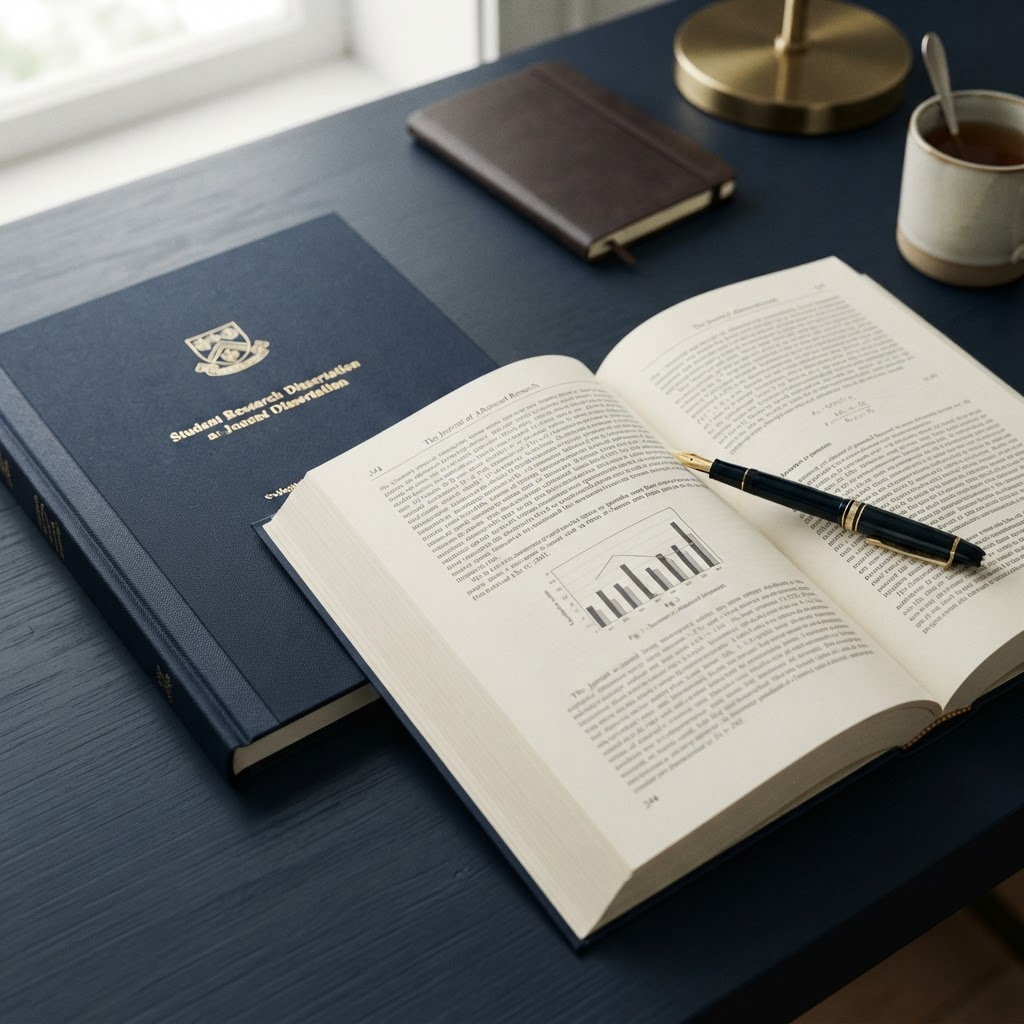
An EPQ and a journal paper are assessed on opposite things. AQA gives 40% of the marks to Develop and Realise and 20% to Review — your process and your reflection on it. A journal cares only about whether the finding is sound. Converting one to the other is not editing; it is rebuilding the argument around a result instead of around a journey. Most EPQs cannot be converted, and knowing which yours is saves months.
Roughly nobody does this, which is strange, because a large number of sixth formers each year produce a 5,000-word piece of independent research and then file it.
The EPQ is the most under-exploited qualification in the UK. It is externally assessed, it carries UCAS points, your school supervises it, and it costs your family nothing. And for a subset of students, it contains a genuine finding that a journal would consider.
The conversion is real work. Here is what it involves and how to tell whether yours is a candidate.
What is the EPQ actually assessing?
Start here, because it explains everything that has to change.
AQA's Level 3 Extended Project Qualification has four assessment objectives:
| Objective | Weight | What it measures |
|---|---|---|
| AO1 Manage | 20% | "Identify, design, plan, and carry out a project" |
| AO2 Use Resources | 20% | "Research, critically select, organise and use information" |
| AO3 Develop and Realise | 40% | Skills, problem-solving, "take decisions critically and achieve planned outcomes" |
| AO4 Review | 20% | "Evaluate all aspects of the extended project" |
A research-based report runs to "approximately 5000 words." You also keep a production log documenting "the planning and progress of the project, including decision-making and the student's reflections on the process," and you deliver a live presentation "for a non-specialist audience."
Read that table again. Eighty per cent of the marks are for how you worked and what you learned about working. The finding itself is almost incidental.
A journal inverts this completely. Reviewers do not care how you organised your time, what you would do differently, or how you developed as a learner. They care whether the question is worth asking, whether the method answers it, and whether the conclusion follows from the data.
That is the gap you are closing.
Is your EPQ a candidate?
Be honest here, because the answer is no more often than yes.
Your EPQ is probably convertible if:
- You collected or analysed data yourself — a survey, an experiment, a dataset, a corpus of texts, a set of documents
- You can state a finding in one sentence that someone could disagree with
- Your method is describable in enough detail that another person could repeat it
- The question was narrow
It probably is not if:
- It is a literature review or a discursive essay with no original analysis. These are perfectly good EPQs and there is nowhere to send them.
- The question was broad — "Is nuclear power the answer to climate change?" has no finding, only a position
- Your evidence is entirely secondary, drawn from other people's summaries
- You cannot say what would have proved you wrong
The second list is not a failure. Most EPQs are argumentative essays, that is what the qualification was designed to allow, and an unconvertible EPQ is still worth 28 UCAS points at A* and still answers UCAS Question 3 perfectly well.
What actually has to change?
Six things, roughly in order of effort.
1. The structure changes entirely. An EPQ typically runs chronologically — here is what I wondered, here is what I read, here is what I did, here is what I found, here is what I learned. A paper runs: abstract, introduction, literature, methods, results, discussion, conclusion. The reader must be able to skip to the methods without reading anything before it.
2. The reflection comes out. All of it. Everything you wrote for AO4 — what you would do differently, how your time management improved, what the project taught you about yourself — has no place in a paper. This alone often removes 800 words.
3. The first person mostly goes. Some journals accept "we"; almost none want "I found this really interesting." Write about the work, not about doing the work.
4. The literature section gets rebuilt around a gap. In an EPQ, the reading demonstrates AO2 — that you found and used sources. In a paper, the literature exists to establish why your question had not already been answered. Different purpose, different selection, usually different sources. Our guide to writing a literature review covers the distinction.
5. The methods become reproducible. EPQ methods sections are often a page. Journal methods sections must contain enough for another person to repeat the study exactly: sample size and how it was chosen, instruments, procedure, what was excluded and why, how the analysis was run.
6. The limitations become specific and honest. "I would have liked more time" is an EPQ limitation. "The sample was self-selecting because recruitment ran through one school's mailing list, which likely biases toward higher-attaining students" is a paper limitation. Reviewers read this section closely, and vagueness here sinks more student submissions than weak findings do.
How much shorter does it get?
Usually a lot, and this surprises people.
An EPQ dissertation runs around 5,000 words. The Journal of Research High School strongly recommends under 4,000 words excluding abstract and references. Strip the reflection, the process narrative and the personal framing, tighten the literature to what supports the gap, and a 5,000-word EPQ typically compresses to 2,500–3,000 words of actual paper — to which you then add a proper methods section and a real limitations section.
Expect to rewrite rather than edit. Students who try to cut their way from one to the other usually end up with a shortened EPQ rather than a paper.
Where would you send it?
That depends on the subject, and the fees and timelines vary considerably. We set out the full picture — acceptance rates, costs, review times and the trade-offs in each — in journals that publish high school research.
The short version: expect three to six months from submission to a decision at any venue that reviews properly, expect to pay somewhere between nothing and $350, and treat any journal that promises a two-week decision with suspicion.
One timing point that matters for UK applicants. If you finish your EPQ in the spring of Year 13, you have already submitted your UCAS application. If you finish it in Year 12 — which many schools now structure for — you can submit over the summer and write "under review at" on your personal statement in October. That single scheduling decision is worth more than most of the advice on this page.
What if it gets rejected?
Then you are in the ordinary position of most researchers, and you have gained something the EPQ alone does not give you.
Reviewer comments from a serious journal are usually the most detailed critique a student has ever received on their own work. They are also excellent interview material: a student who can say "a reviewer pointed out that my control group was not really comparable, and they were right" is demonstrating exactly the independence of thought Oxford's assessment criteria look for.
Revise on that basis and submit elsewhere. That is the normal cycle of academic work, and having been through it once at eighteen is a genuine advantage.
Do you need help to do this?
Not necessarily, and it is worth saying that plainly.
If your EPQ supervisor has a research background, ask them. If a subject teacher has a PhD — more common in sixth forms than students realise — ask them. If you cold-emailed an academic during the project, go back to them with the draft; people who have already replied once often reply again. Our guide to finding a research mentor covers how to ask.
Where a mentored programme helps is when nobody around you has published anything, and you cannot tell whether your methods section is reproducible because you have never read a good one. That is what our Oxford Publication Fellowship is for, and it is the expensive answer to a question you should first try to answer for free.
Frequently asked questions
Can an EPQ really be published in a journal?
Some can. An EPQ with original data, a narrow question and a reproducible method is a legitimate candidate for a journal that publishes school-age research. A discursive essay or literature review has no natural venue, and that is not a criticism of it — most EPQs are that, by design.
How many UCAS points is an EPQ worth?
AQA describes it as "worth half an A-level (28 UCAS points)" at grade A*. Note that Oxford and Cambridge make grade-based offers and do not use the UCAS Tariff, so for Oxbridge applicants the value of an EPQ is the work and the interview material, not the points.
Should I do my EPQ in Year 12 or Year 13?
Year 12 if your school allows it. Finishing in Year 12 means you can submit to a journal over the summer and have something live to write about in your personal statement in October. A Year 13 EPQ finishes after your application has gone.
How long does it take to convert an EPQ into a paper?
Realistically a few weeks of focused work, spread over longer. It is a rewrite rather than an edit — the structure, the framing and the methods section all change substantially, and the reflection comes out entirely.
Will a journal reject it for being school work?
Not at the venues that exist for this. Several journals publish exclusively school-age research and assess submissions on the same criteria they would apply to anyone: is the question clear, is the method sound, does the conclusion follow.
Is the published paper worth more than the EPQ itself?
Not necessarily. The EPQ is externally assessed and recognised by every UK university. A publication in a venue with a low acceptance rate adds credibility; one in a venue that publishes nearly everything adds little. What both give you is something you can be questioned about in depth, which is the thing that actually matters.