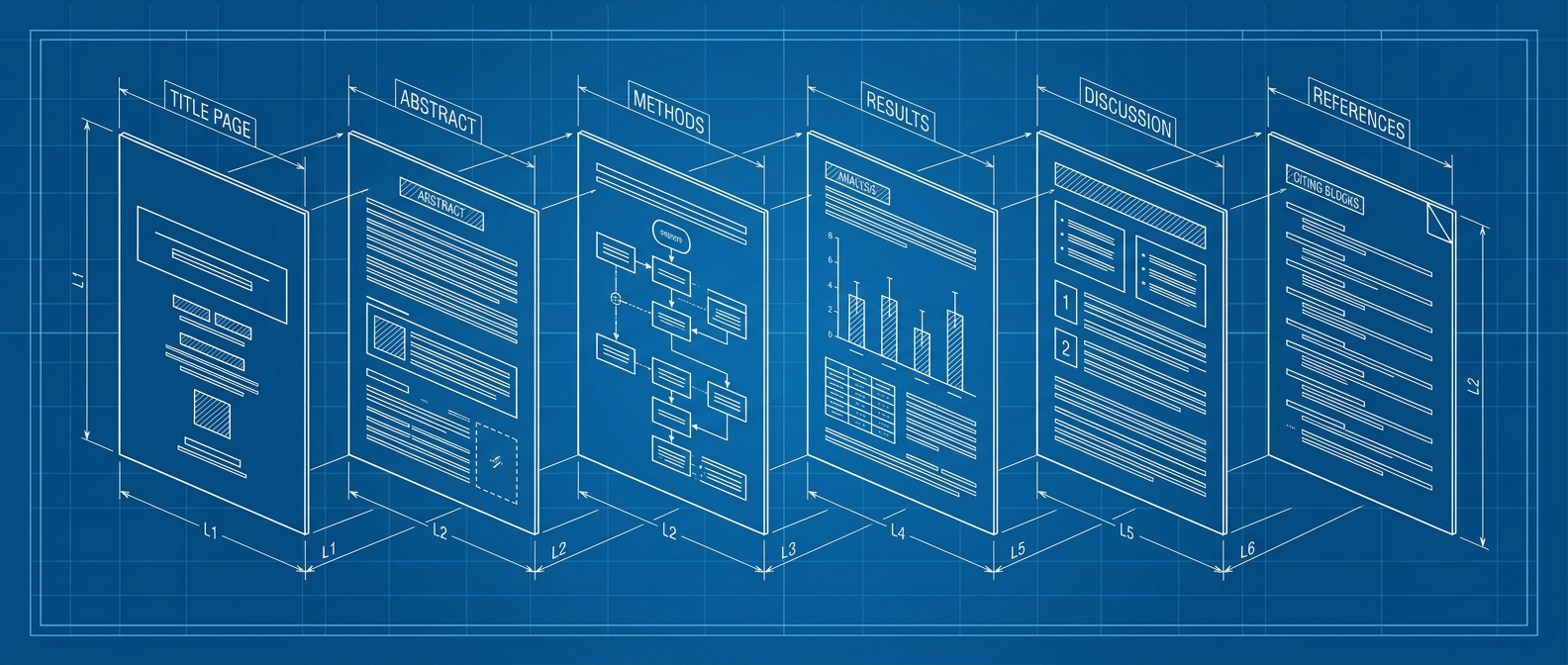
A research paper has six sections in a fixed order, and you should write them in a different order from the one they appear in. Methods first, then results, then introduction, then discussion, then conclusion, then abstract last. Budget your words: methods and discussion together should be nearly half the paper, because that is where the marks and the reviewer goodwill are.
Most students write a research paper the way they write an essay: start at the top, finish at the bottom. That produces a paper where the introduction promises something the results do not deliver, and a discussion written at 2am the night before.
The structure is fixed. The writing order is not, and it should not match.
The structure
Six sections, in this order in the finished paper:
| Section | What it does | Word budget (5,000-word paper) |
|---|---|---|
| Abstract | Summarises the whole paper | 150–300 |
| Introduction | Establishes the question and why it matters | 800–1,000 |
| Methods | Says exactly what you did and why | 800–1,200 |
| Results | Reports what you found, without interpreting | 600–1,000 |
| Discussion | Says what it means | 1,200–1,500 |
| Conclusion | States the contribution and what follows | 200–400 |
This is IMRaD — Introduction, Methods, Results and Discussion — the standard form of an empirical paper, and what essentially every journal expects.
Note the budget. Methods and discussion together take nearly half the paper. That is deliberate, and it is where most student papers are mis-proportioned: a long introduction reviewing the literature, a two-paragraph method, and a discussion that stops after the limitations.
Check your target length before you draft. AP Research requires 4,000 to 5,000 words. The Oxford Journal of Student Scholarship expects most papers between 2,000 and 8,000 words with abstracts of 150 to 300 words. Writing 6,000 words for a venue that wants 3,000 is a rewrite, not an edit.
Write them in this order
1. Methods. Start here. You know what you did, nothing needs interpreting, and the detail is freshest now. Writing it first also surfaces the gaps in your record — the exclusion you did not note, the recruitment detail you cannot reconstruct — while there is still time to fix them.
2. Results. Also factual. Report; do not interpret. "Group A scored higher (M = 14.2) than Group B (M = 11.8)" belongs here; "this suggests that..." belongs in the discussion.
3. Introduction. Now that you know what the paper actually found, you can write an introduction that sets it up. Written first, an introduction promises the study you hoped to run.
4. Discussion. The hard one. Allow a week.
5. Conclusion. Short, and no new material.
6. Abstract. Last, always. It summarises a finished paper.
Methods: write a justification, not a procedure
This is the section students most reliably under-write, and it carries disproportionate weight.
A procedure reads: A questionnaire was distributed to 84 students in Years 12 and 13. Responses were collected over two weeks and analysed in SPSS.
Every word is true, and it scores in the middle band, because nothing explains why.
A justification reads: A questionnaire was chosen over interviews because the question concerns prevalence rather than mechanism; a sample of this size allows comparison between year groups while remaining collectable within the project window. The instrument cannot capture why students answered as they did, which the discussion addresses.
The AP Research academic paper rubric awards 7 of 50 points for "a rationale for the chosen approach, method, or process in relation to the research question" — and its top holistic band requires a replicable method. Journals treat the same thing as basic competence.
So your methods section must answer:
- What exactly did you do, in enough detail that a stranger could repeat it?
- Why that method, for this question?
- Who or what was in your sample, and how were they selected?
- What was excluded, and why?
- What can this design not show?
That last one belongs here as well as in the limitations. Naming your design's ceiling in the methods is a mark of a competent author, not a confession.
Results: resist interpreting
Three rules.
Report, do not interpret. Numbers, patterns, what the analysis returned.
Tables and figures must do work. Every exhibit needs a caption saying what the reader should take from it. The AP rubric gives 3 points to whether organisational and design elements engage the reader and demonstrate credibility, and College Board's own 2024 sample paper that scored a 4 was marked down partly because its tables and design choices did not fully enhance communication. Decorative tables cost marks.
Report everything, including what did not work. The failed pilot, the analysis that returned nothing, the question nobody answered. Selective reporting is the integrity problem that most often starts innocently.
Discussion: the section that decides the paper
Four jobs, in this order.
1. What do the results mean? Interpret and synthesise, so the reader leaves with one picture rather than six separate numbers.
2. How does this relate to existing work? Does it agree with the literature, contradict it, extend it? Name the papers and say how.
3. What are the limitations? A real limitations section names what would change your conclusion — not just that the sample was small. "A single-school sample may reflect that school's streaming policy rather than a general effect" is a limitation. "The sample was small" is an apology.
4. What follows? The "so what". Who should do something differently, and what?
That fourth job is worth up to 7 points on the AP rubric, which asks for the consequences and implications of the conclusion in context — and it is the thinnest section in most student papers, because it gets written last by an exhausted author. Write it while you still have energy.
Reviewers' most common complaint about student papers is that conclusions overreach. The fix is almost always to narrow the claim, not to add evidence. Our guide to whether your research is good enough to publish covers the mismatch test.
Introduction: four moves
Written after the results, the introduction becomes mechanical:
- The topic and why it matters — connect it to the wider field, which the AP rubric's Context row rewards with up to 6 points.
- What is known — the literature, with sources related to each other rather than summarised in sequence. Our guide to writing a literature review covers that move specifically.
- The gap — what has not been established, and why that matters.
- Your question, and the scope — stated precisely, with the limits of the inquiry named.
That last element is the one students omit. Scope is something you state, not something the reader infers.
Abstract and conclusion
The abstract is the last thing you write and the first thing anyone reads. In 150 to 300 words: the question, the method, the main finding with a number, and the implication. No citations, no hedging, no "this paper will attempt to". Our guide to writing an abstract covers the formula.
The conclusion restates the contribution in two or three sentences and says what should follow. No new material, no new citations.
Voice, citation and integrity
Twelve points on the AP rubric go to writing conventions, and journals treat the same issues as integrity questions rather than style ones.
The central requirement: the reader must always be able to tell which claims are yours and which are the literature's. The AP rubric's top band asks you to integrate others' ideas effectively while "consistently distinguishing the student's voice from theirs."
Journals enforce this hard. OJSS states that papers found to include plagiarism or AI-generated writing will not be considered. And the ICMJE authorship criteria require authors to be accountable for all aspects of the work, including investigating and resolving questions about its accuracy and integrity — which you cannot be for text you did not write.
Practically: attribute explicitly, keep your assertions in your own sentences, and cite nothing you have not read.
Before you call it finished
Four checks that take an afternoon.
Read it aloud. Finds most of what costs you the word-choice and syntax marks.
Check every claim against its evidence. Especially in the conclusion.
Check every citation resolves to a source you have actually read.
Give a full draft to someone who knows the subject, and ask for written comments. This is the highest-value thing available to you and it is free. Our guide to who can supervise a student research project covers finding that person.
Then, if you are submitting, our guides to where high school students can publish and what happens after you submit cover what comes next — and plan for it, because review takes months. Our research project timeline has the realistic durations.
Frequently asked questions
How long should a high school research paper be?
Depends on the destination. AP Research requires 4,000 to 5,000 words. The Oxford Journal of Student Scholarship expects most papers between 2,000 and 8,000 words with a 150 to 300 word abstract. Check your target before drafting, because a paper written to the wrong length is a structural rewrite rather than a trim.
What is IMRaD?
Introduction, Methods, Results and Discussion — the standard structure of an empirical research paper, usually with an abstract at the front and a conclusion and references at the back. Almost every journal expects it, and deviating from it without reason makes a paper read as unfamiliar with the form.
Which section should I write first?
Methods. You already know what you did, it requires no interpretation, and it is the easiest section to write while the detail is fresh. Writing it first also exposes gaps in your record before you have built conclusions on top of them.
What is the hardest section to write?
The discussion, and it is also the most valuable. It has to say what your results mean, how they relate to existing work, what the limitations are, and what should follow. The AP Research rubric puts 7 of its 50 points on the consequences and implications of your conclusion, and reviewers cite a thin discussion more than any other weakness.
Do I write the abstract first or last?
Last, always. An abstract summarises a finished paper. Written first, it summarises your intentions, and then quietly constrains the paper into matching them even after your findings have moved on.
How many references does a student research paper need?
Enough to establish what is already known and to support every claim that is not your own finding — usually fifteen to forty for a paper of this length. Quality matters more than count. Prefer primary sources over summaries, and never cite something you have not read.