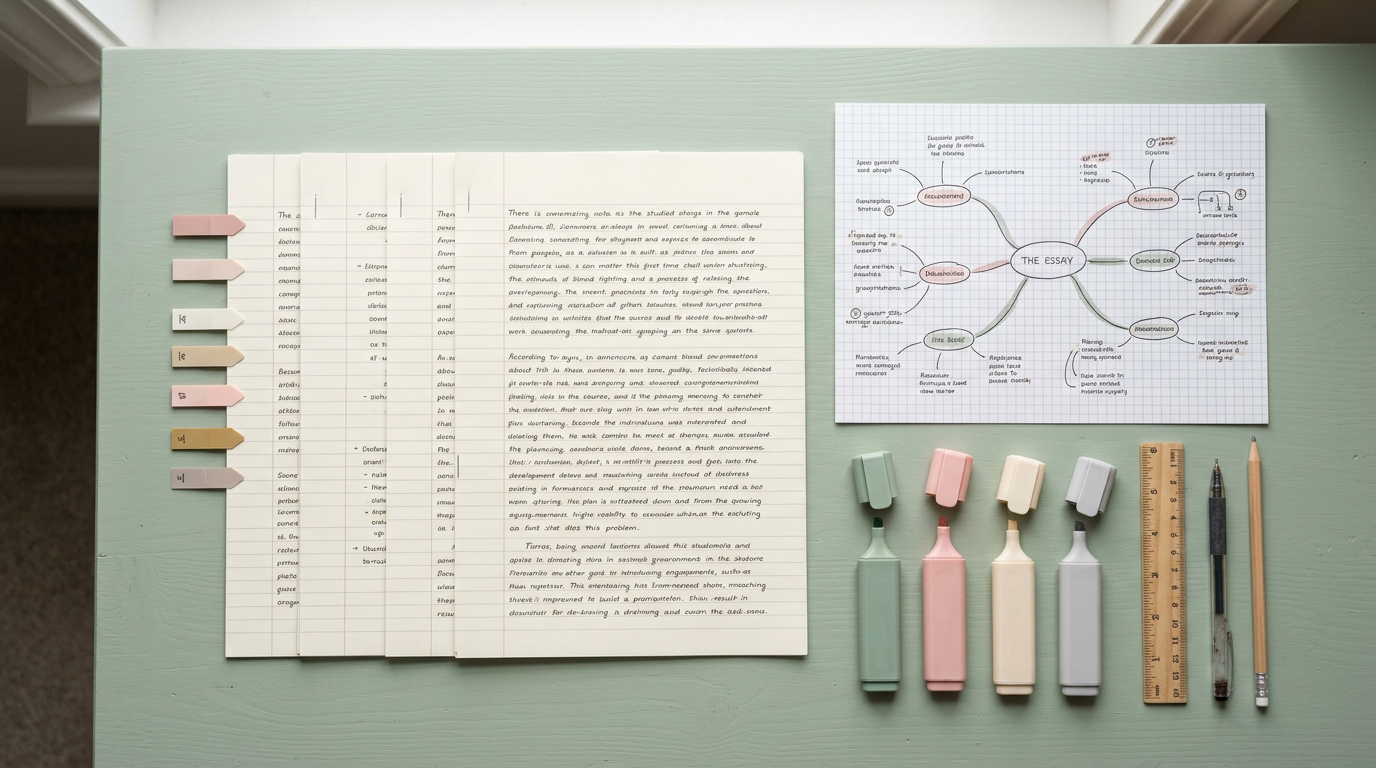
The Extended Essay's three constraints — 4,000 words, one subject, one assigned supervisor — are not obstacles. They are the only things preventing the failure mode that kills most of these essays, which is a question too broad to answer. Choose inside the constraints in week one and the rest is execution.
Students treat the Extended Essay's rules as obstacles. They are the only thing standing between you and the failure mode that accounts for most weak essays: a question nobody could answer in 4,000 words.
The three constraints, and why each helps
Four thousand words. Examiners stop at the limit. That cap rules out any question whose literature review alone would run to 1,500 words — which is most of the questions students arrive with, and discovering it in January is much worse than accepting it in September.
One subject. Your essay is marked against that subject's criteria, using that subject's methods. A brilliant question answered with the wrong discipline's tools scores badly. This feels restrictive and it is what makes the question findable: you are not searching all of human knowledge, you are searching one field.
One assigned supervisor, and three reflection sessions. The sessions are assessed. Students who treat them as paperwork and write them up retrospectively lose marks that were free, and it shows — a reflection written in April about a decision made in October reads exactly like one.
Compare this with the EPQ, which has none of these constraints and where students consequently stall in February with no question at all. The EE's structure is doing work.
The test for a question
One sentence: can you say what evidence would change your answer?
"To what extent is social media harmful to adolescents?" fails. No obtainable evidence settles it, and 4,000 words will produce a tour of other people's arguments.
"To what extent does self-reported daily screen time predict self-reported sleep duration among US 12th graders in the 2023 Monitoring the Future survey, controlling for sex and region?" passes. The data exists, the analysis is reachable, and a result could surprise you.
Two more checks before committing:
Does someone disagree? Find two sources taking different positions. A question answerable from a single textbook has nowhere to go.
Would any result surprise you? If not, the question is closed and you will spend six months confirming what you already believe.
Choosing by subject group
The question-finding move differs by group, and most guides skip this.
| Group | Where questions come from | Common failure |
|---|---|---|
| 1 and 2 — Language and literature | A specific textual feature across defined texts | Choosing a theme rather than a feature |
| 3 — Individuals and societies | A dataset you can open, then a variable pairing | Choosing a topic with no obtainable evidence |
| 4 — Sciences | An experiment you can run, or published data | Designing something needing a lab you cannot use |
| 5 — Mathematics | A result you can derive or test computationally | Restating textbook material |
| 6 — The arts | A comparison between specific works or practices | Appreciation rather than analysis |
For Group 3 and 4 essays, the most reliable method inverts the usual advice: find the data first. Open something you can reach, spend an hour in its documentation, and look for a variable pairing nobody has checked. Narrow questions come from data, not brainstorming. Our list of free datasets covers twenty-two sources.
For a Group 4 essay that needs equipment, note that most universities bar under-eighteens from BSL-2, radioactive and animal work. The computational corner of your field is usually the better route — research without a lab covers it.
Thirty worked EE questions, grouped by subject group with a source attached to each, are a faster starting point than a blank page.
A timeline that survives the Diploma
The EE's real competitor is everything else in IB1 and IB2.
| When | What |
|---|---|
| First reflection session | Arrive with three candidate questions, not one |
| Weeks after | Kill two. Fix the subject and the evidence base. |
| Research phase | Write as you go. Never read for six weeks then start. |
| Second reflection session | Bring a partial draft, not a progress report |
| Draft deadline | Submit a complete draft — this is your one marked draft |
| After feedback | Revise. Resize the conclusion to what the evidence supports. |
| Final reflection (viva voce) | Be able to say what you would do differently |
The single highest-value habit is writing from the start of the research phase. Students who read first and write later cannot remember in February why they saved half their sources, which is exactly what the reflection record exists to prevent.
Using your supervisor properly
They can do more than most students ask for.
Your supervisor may discuss your topic with you, read one complete draft and give written feedback on it, and conduct the reflection sessions. They cannot edit your work or write any part of it.
That one marked draft is the most valuable thing in the process and students routinely waste it by submitting something unfinished. A subject specialist telling you your method does not support your claim is precisely what a research mentor does in the first three sessions, and here it is free and built in.
Arrive at the first session with three candidate questions and an honest sentence on what evidence exists for each. A supervisor can choose between three; they cannot do much with one you are already attached to.
The commonest mistakes
A topic wearing a question's clothes. "Climate change and migration" is a field. If your question does not name the specific things being compared, you have not finished choosing.
A question needing a lab you do not have. Change the question rather than waiting for an email reply that is unlikely to come — one Stanford lab that publishes its policy takes a high school student roughly once every four to five years.
Surveying your own year group. Ninety respondents rarely supports the claims students want to make, and it raises consent questions your school will have a policy about.
Retrospective reflections. Assessed, and visibly written at the end.
Over-claiming in the conclusion. You found a correlation; say so, name what you could not control for, and state what would be needed to go further. Examiners and reviewers both trust a piece that names its own limits.
What it is worth afterwards
Two honest points.
The EE is a compulsory component of a Diploma that UK and US universities recognise. Unlike the EPQ, it carries no published reduced-offer advantage in the UK system — but it gives a tutor twenty minutes of material at interview, which is the mechanism that actually matters.
Yale asks applicants to state "your specific contributions if the work was done in collaboration with others," and Caltech reports that 42% of admitted students submitted research while routing independent work to a portfolio. Beyond those, almost nothing is published about weighting.
Can you publish it? Usually not as written — journals want original findings and a methods section, while an EE is an argument with a reflection component. Our guide to converting an Extended Essay sets out what would have to change, and if publication interests you, pick a question with a dataset behind it now rather than later.
Where we fit
The Oxford Centre for Advanced Research pairs students with PhD candidates and early-career researchers at Oxford, Cambridge, other leading UK universities and Ivy League institutions. The Oxford Scholar Programme is £2,000 — about $2,600 — for ten contact hours over ten to fourteen weeks.
The EE comes with a supervisor built in. For most students that supervisor, used properly, plus a teacher with a doctorate, is enough — and the whole method above is on this page for nothing. Students come to us when they want to take the work past what the Diploma requires, usually toward submission.
Week one
Write three candidate questions, each naming its variables and its evidence source, and take all three to your first reflection session.
Students who arrive with three finish over the summer. Students who arrive with one spend the autumn defending it.
Frequently asked questions
What makes a good Extended Essay question?
It names the specific things being compared, it can be answered using one subject's methods, and you can say in one sentence what evidence would change your answer. 'To what extent is social media harmful' fails all three. A question naming two variables, a population and a dataset passes all three.
How long is the Extended Essay?
Four thousand words, and examiners stop reading at the limit. That cap is the single most useful constraint available to you — it rules out any question whose literature review alone would run to 1,500 words, which is most of the questions students arrive with.
Which subject should I choose?
One you are studying, and usually one where your question is answerable with evidence you can reach. The EE is marked against that subject's criteria, so a psychology question answered with historical methods scores badly however well written. Pick the discipline first, then the question.
How much help can my supervisor give?
They can discuss your topic, read one complete draft and give written feedback on it, and hold the reflection sessions. They cannot edit your work or write any of it. Students consistently under-use what is permitted — one properly marked draft from a subject specialist is worth more than any amount of independent redrafting.
What are the reflection sessions for?
They are assessed, which surprises people who treat them as paperwork. Three formal sessions with your supervisor are recorded as you go, and the reflection on planning and progress carries marks of its own. Writing them retrospectively at the end is both obvious to an examiner and a waste of the marks.
Can I write about something outside my subjects?
Generally your EE sits in a subject you study, and schools usually require it. The flexibility is in the angle — a history essay about a scientific controversy, an economics essay about sport, an English essay on a text nobody else in your cohort has chosen.