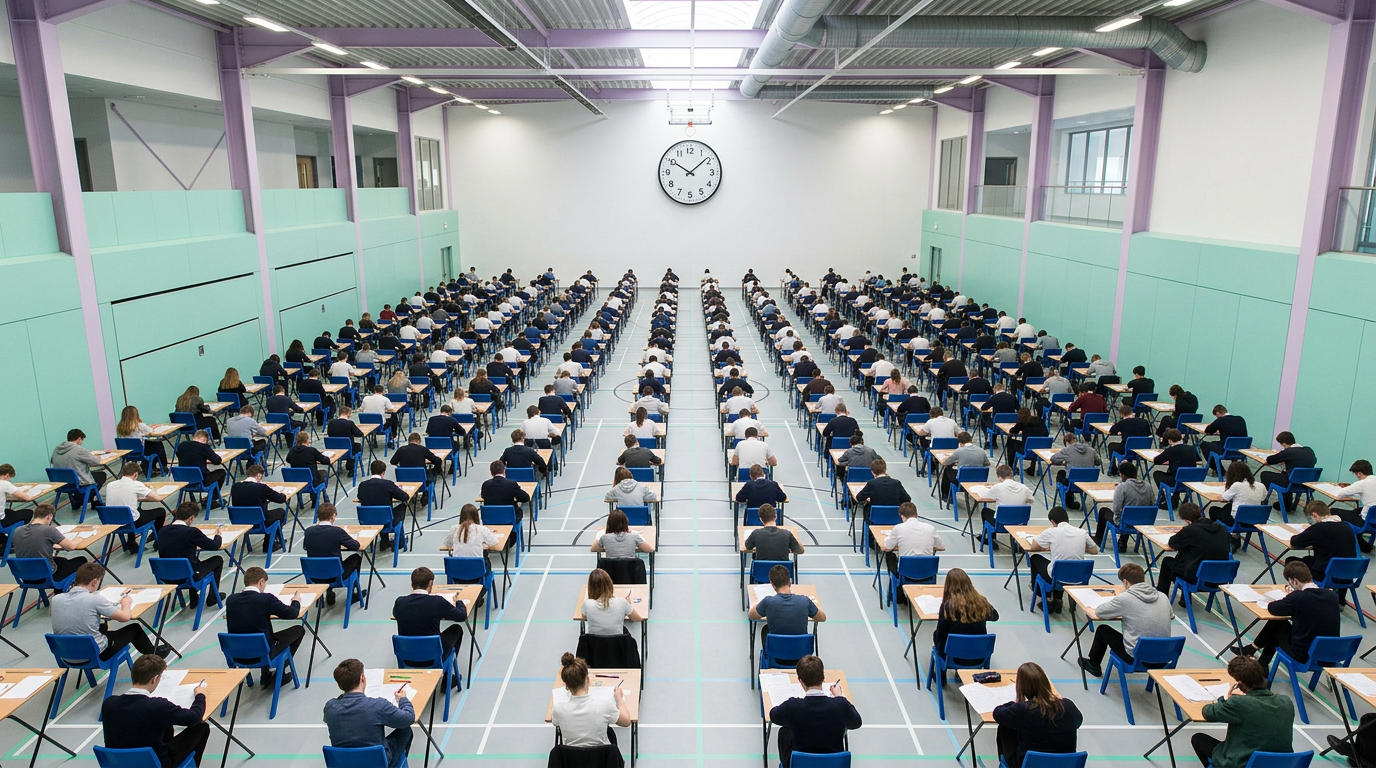
Academic competitions split three ways and the difference decides whether you can enter at all. Olympiads run through your school, on fixed dates, and progress by qualifying score — if your school does not register you, you cannot sit them. Research fairs need an original project finished months ahead. Essay prizes you enter yourself, free, with a few weeks' notice. Work out which type you are looking at before you plan a year around it.
Most competition lists are twenty names and twenty dead links. The dates have moved, several have closed, and none of them tell you the thing that actually decides whether you can enter.
So this list is sorted by what the competition demands of you, because that is the constraint.
| Type | How you enter | Lead time | Cost |
|---|---|---|---|
| Olympiads and challenges | Through your school, fixed dates | Register in September | A few pounds per entry |
| Research fairs | Original project, often via a regional fair | 6–12 months | Usually free |
| Essay and writing prizes | Yourself, directly | 4–8 weeks | Usually free |
Olympiads and subject challenges (1–9)
These are timed papers your school administers on a fixed national date. They progress by qualifying score. They are the best value in this whole article — a few pounds, no project required — and the single reason students miss them is administrative.
1–4. The UKMT senior progression. The UK Mathematics Trust runs the clearest ladder in UK school academia. The Senior Mathematical Challenge is the entry point, open to Year 13 and below in England, Wales and overseas, S6 or below in Scotland, and Year 14 or below in Northern Ireland. The 2026 paper sat on Wednesday 7 October, 90 minutes, and — new for 2026 as a trial — 22 multiple-choice questions plus three questions answered as a number from 000 to 999.
From the SMC you progress by qualifying score or discretionary entry to the Andrew Jobbings Senior Kangaroo (several thousand UK students qualify each year; UK schools only) and to British Mathematical Olympiad Round 1 (around 1,000 qualify). BMO2 follows from BMO1 and is the entry point to the training and selection programme for the international competitions.
Cost: £16 per pack of ten posted papers, or £15 per pack of ten to download and print. All UKMT competitions are now paper-format only.
Two practical notes. Individual entry is not offered — the route is register your school, purchase entries, sit the challenge. And UKMT tightened security in 2026: following paper leaks during the SMC, the BMO1 question paper became available for teachers to download only from 00:01 on the morning of the olympiad.
5–6. The girls' parallel competitions. UKMT also runs the Mathematical Olympiad for Girls, which allows up to four discretionary entries per school, and the Mathematical Competition for Girls, which allows unlimited discretionary entries. The discretionary allowance matters: these are routes in that do not require an SMC qualifying score.
7–9. The science olympiads. The British Physics Olympiad, the Royal Society of Chemistry's UK Chemistry Olympiad, and the Royal Society of Biology's Biology Olympiad run the same pattern — a school-administered paper, national medals, and selection routes toward the international olympiads. Entry is through your school and the dates are fixed annually, so confirm with your head of department in the autumn term. The British Informatics Olympiad and the UK Linguistics Olympiad work similarly for computing and languages.
The one thing to do about this whole category: email your heads of maths and science in September asking which competitions the school registers for. That single email is worth more than reading any list, because the barrier is never your ability — it is whether somebody bought the papers.
Research competitions (10–14)
These need a finished original project, which means a year of lead time and a decision made long before the deadline.
10. Regeneron Science Talent Search. The most prestigious high school research competition in the world, and the one whose rules most students get wrong. From the Society for Science's own FAQ:
- Over 2,600 apply annually; 300 are named scholars; 40 become finalists
- $3.1 million in total awards; top award $250,000; the 300 scholars receive $2,000 each with a further $2,000 to their school
- The 2027 cycle opened 1 June 2026 and closed 5 November 2026; the 2028 cycle opens 1 June 2027 and closes early November 2027
The eligibility rule that excludes most readers of this page: you must be living in and attending your last year of secondary school in the US or its territories — though, importantly, "regardless of citizenship". US citizens living abroad may qualify. Students at American schools abroad who are not US citizens are not eligible.
And the project rules are strict in ways worth knowing before you build a project hoping to enter: independent individual research only, no team entries and no splitting a team project; the project must have data and results, and literature reviews are not permitted; the submission is a maximum 20-page original scientific paper. Mentors are allowed, including parents and institutional scientists, but your independent role must be clear and disclosed. Published work is allowed, and recommended only where you are first or sole author. Generative AI must be disclosed and may not be used to write application questions, draft the research report or generate citations.
11. Regeneron ISEF. The international fair, which students generally reach through an affiliated regional fair rather than by direct application. It is the main route open to students outside the US, and the affiliated-fair network is the thing to look up for your own country.
12–14. Project and innovation challenges. The Breakthrough Junior Challenge (a short explanatory video on a scientific concept), the Conrad Challenge and the Diamond Challenge (team innovation and entrepreneurship) all accept original student work on different formats and are open internationally. Their value for a research-minded student is that a project built for a journal can often be re-presented for one of these without new data.
If you do not yet have a project, our guides to research topics by subject, free datasets and research without a lab cover how to produce one, and our research project timeline covers fitting it around exams.
Essay and writing prizes (15–20)
The only category you can enter without anyone's permission.
15. The John Locke Global Essay Prize. Free, open to anyone under 19 from any country, 2,000 words, ten subject categories. First prize in each category is a US$5,000 scholarship to a John Locke Institute programme; the best essay overall takes a US$10,000 Junior Fellowship. In 2026 registration opened 2 February and submissions closed 31 May. The 2027 questions are not yet published. Our full guide covers the rules and the judging note that matters.
16. The Queen's Commonwealth Writing Competition. Run by the Royal Commonwealth Society since 1883 and described by it as the world's oldest international writing competition for schools. Note the name: it is now the Writing Competition, though the society's own page still uses the older "Essay Competition" in places. Regional winners and their families get a week of cultural and literary activities in the UK, culminating in an award ceremony at Buckingham Palace.
17. The Orwell Youth Prize. Run by the Orwell Foundation and open to anyone in Years 7–13 at school or college in the UK, or studying a British curriculum abroad. The 2027 prize is open now on the theme "Acts of Courage". Its distinctive feature is genuinely unusual: entrants receive individual feedback on a first draft, free. Winners can be published in The Observer, with a cash prize and books.
18. The Harvard Crimson Global Essay Competition. For ages 13–18, 500 words maximum, three tracks. Worth understanding what it is before entering — it is run in partnership with The Harvard Crimson newspaper and Crimson Education, not by Harvard University. Our guide to it sets out the detail.
19–20. Oxbridge college and subject-society prizes. Individual Oxford and Cambridge colleges and faculties run essay prizes in specific subjects, often with far smaller fields than the national competitions. They are poorly publicised, which is exactly why they are worth finding: search the college and faculty sites for your subject directly rather than relying on aggregated lists.
Our guide to writing competitions for high school students covers this category in more detail.
What to actually do
Three actions, in order of value:
- September: email your heads of department and find out which olympiads your school enters. This is the highest-return thing on this page.
- Autumn: pick one essay prize and put the deadline in a calendar. You can do this alone, for free.
- Whole year: run one research project. Competitions rank you against a field; a project is evidence you can do the work. Our guide to what counts as original research covers the bar, which is lower than most students assume.
And a caution on lists, including this one: dates move every year and competitions close without notice. Check the organising body's own page before you plan anything around a date you read somewhere else — as the John Locke Institute's own out-of-date page shows, even the primary source needs reading carefully.
Frequently asked questions
What are the best academic competitions for school students?
It depends what you have. If you have a school that registers for olympiads, the UKMT and science olympiad routes are the highest-value entries available and cost almost nothing. If you have an original research project, the research fairs carry the most weight. If you have neither yet, essay prizes are the only category you can enter unilaterally, this term.
Can I enter an olympiad if my school does not?
Usually not. UKMT competitions are a school-registration process — the school registers, buys entries and administers the paper, and individual entry is not offered. The practical move is to ask a head of department in September rather than discovering in October that nobody registered.
Which competitions can I enter on my own?
Essay and writing prizes, almost all of them. The John Locke Global Essay Prize is free and open to any student under 19 from any country. The Orwell Youth Prize takes anyone in Years 7–13 at a UK school or on a British curriculum abroad. Research fairs normally require a school or regional-fair route.
Do competitions matter as much as research for university applications?
They do different things. A competition result is a comparative signal — somebody ranked you against a field. A research project is evidence you can do the work itself. UK admissions assess subject aptitude against the specific course, so what tends to carry weight is being able to discuss something you did in depth, whichever category it came from.
How selective are the top research competitions?
Very. The Regeneron Science Talent Search takes over 2,600 applicants a year, names 300 scholars and invites 40 finalists — and it is restricted to students in their last year of secondary school in the US and its territories. Most international students are not eligible for the US research fairs at all.
When do competition deadlines fall?
Earlier than most students expect, and they cluster. UK olympiads run from October to February on fixed school-administered dates. The Regeneron STS closes in early November, more than a year before the results. Essay prizes mostly open in the spring. Check in September for the whole year.