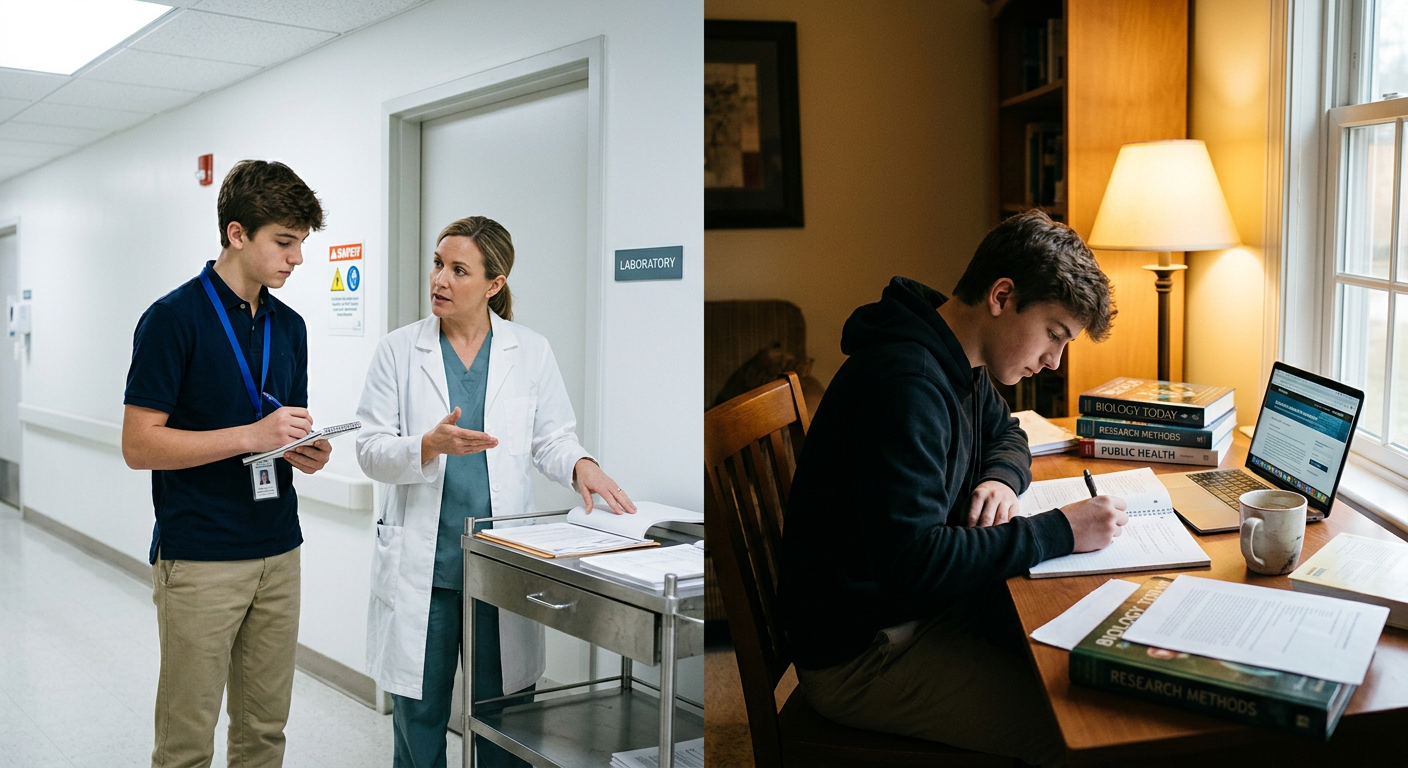
For medicine, work experience wins — the Medical Schools Council states there is 'no set number of hours or specific type of experience required' and that what matters is reflection, so a care home counts as much as a hospital. For research-led courses, a finished project usually does more, because it produces something you can be questioned on.
The two are usually discussed as if they were competing for the same slot. They are not, and which one matters depends almost entirely on what you are applying for.
For medicine: work experience, and the guidance is unusually clear
This is the one case where there is an authoritative published answer rather than inference.
The Medical Schools Council's guidance on relevant work experience states that "there's no set number of hours or specific type of experience required." What it asks for instead is reflection: "What matters most is how well you reflect on what you've learned."
That single sentence undoes most of what students are told about medicine applications.
What the Council explicitly counts:
| Counts | The Council's own wording |
|---|---|
| Care homes, hospices, schools, community groups | "volunteering or working in care homes, hospices, schools, or community groups" |
| Ordinary paid work with people | "customer service or team-based jobs that involve interacting with people" |
| Caring for a family member | counts "if reflected on appropriately" |
| Hospital shadowing | One option among several — explicitly not required |
It also advises variety over repetition — "avoid repeating the same type" of shadowing — and that experience should be recent, within two years of applying.
The practical consequence is large and widely ignored. A student who cannot get hospital shadowing because they have no family connections is not disadvantaged by that fact, provided they work somewhere that involves care or responsibility and think seriously about it afterwards. The Council's framing — "focus on what you learned about yourself, others, and healthcare—not just what you did" — is an instruction about the writing, not about the venue.
A research project does not substitute for this. It can sit alongside it, and for an academic foundation programme or an intercalated-degree ambition it is genuinely relevant, but it does not answer the question medicine admissions are asking.
For research-led courses: usually the project
Economics, engineering, the sciences, psychology, history, PPE and their relatives select on a different thing.
These courses are asking whether you can sustain independent academic work, and the honest difference between the two options is what they leave behind.
| Work experience | Research project | |
|---|---|---|
| Duration | Days to a few weeks | Three to four months, part time |
| What it produces | An experience to describe | A document you can be questioned on |
| Interview exposure | Two or three minutes | Twenty minutes, if they want it |
| Fails when | It becomes a list of things you observed | The work is better than you can defend |
| Hard to fake | Moderately | Very — the questions find you out |
The asymmetry at interview is the real argument. A tutor can ask about your project for as long as they like: what you did, why that method, what you would do differently, what is wrong with it. That is a long conversation in which a genuine piece of work keeps giving. A week of shadowing yields a couple of anecdotes, and when they are exhausted the conversation moves on.
That cuts both ways, which is why a project someone else effectively produced is actively dangerous. Yale asks applicants to state "your specific contributions if the work was done in collaboration with others." A student who designed and ran their own analysis answers in a sentence. A student who was the fourth pair of hands on somebody else's project has a much harder paragraph, and interviews find the gap.
What do universities actually say about research?
Less than the market implies, and one institution is the exception.
Caltech reports that 42% of admitted students submitted research, and specifies it should come from "a laboratory in a university or research-affiliated organization" with "a letter of recommendation from site of research." Independent research and internships are directed to a portfolio instead.
Beyond that, almost nobody publishes a position. We looked for standalone statements from Oxford and Cambridge on how research projects are weighted and found none. What does exist is a University of Oxford spokesperson, quoted in Cherwell by Timothy Blackburn in August 2026, making the narrower point that "summer programmes are entirely separate to the University's undergraduate and graduate admissions processes."
So: anyone telling a family confidently how research is weighted at a UK university is guessing, and providers have an obvious incentive to guess high. We are a provider. Weigh that accordingly.
The case nobody makes for work experience
It tells you whether you want the job, which is information a research project cannot give you.
A student who spends two weeks in a care home and finds it draining rather than energising has learned something enormously valuable at very low cost. A student who writes a paper on health inequality has not learned that. Both are worth doing; only one answers the question "is this actually the life I want."
For medicine in particular this is the substance of the exercise rather than a side effect. Reflection is assessed precisely because the Council wants applicants who have tested their assumptions against a real setting.
The case nobody makes for a research project
It is the only one of the two that can fail, and that is the point.
Work experience is nearly guaranteed to produce something describable. A research project can collapse — your question turns out unanswerable, the dataset is unusable, the result is null and uninteresting. Students treat that as the risk. It is also the value: an activity where failure is possible is an activity where success means something.
Most students who attempt independent research do not fail on intellect. They fail because nothing external requires a draft by a particular Thursday. Our comparison of mentored and self-directed work sets out the honest test for which kind of finisher you are, and doing research without a lab covers what is actually possible without equipment.
How to choose, in order
Applying for medicine, dentistry or veterinary medicine? Work experience first, in whatever setting you can genuinely reach, reflected on properly. Add research only if you have capacity left.
Applying for a research-led course? Project first. It does more at interview and it compounds — the EPQ, Extended Essay or AP Research you have to do anyway can often be that project.
Not sure what you are applying for? Work experience, because it narrows the question. Research projects are better when you already know the field.
Running out of time? Work experience. A fortnight in August produces something usable. A research project started in September of your final year produces panic.
Where we fit
The Oxford Centre for Advanced Research runs 1:1 mentorships with PhD candidates and early-career researchers at Oxford, Cambridge, other leading UK universities and Ivy League institutions. The Oxford Scholar Programme is £2,000 — about $2,600 — for ten contact hours over ten to fourteen weeks; the Oxford Publication Fellowship is £3,400, roughly $4,400. We accept approximately 60% of applicants: self-reported and unaudited.
We supervise research projects. We have no work-experience product and no view worth having on how to find one. If you are applying for medicine and have limited time, the Medical Schools Council guidance above is more useful to you than we are, and it is free.
The test either way
Whichever you pick, you should be able to talk about it for ten minutes under questioning without repeating yourself.
If you cannot, you did the activity but you did not do the reflection — and for both routes, the reflection is the part being assessed.
Frequently asked questions
For medicine, which matters more?
Work experience, clearly. The Medical Schools Council says plainly that 'there's no set number of hours or specific type of experience required' and that 'what matters most is how well you reflect on what you've learned'. Research is a supplement to that, not a substitute for it.
Does hospital shadowing count more than a care home?
No. The Council explicitly includes 'volunteering or working in care homes, hospices, schools, or community groups' and even 'customer service or team-based jobs that involve interacting with people'. Caring for a family member counts too, if reflected on appropriately. The setting is not the variable being assessed.
For engineering, economics or the sciences, which is better?
Usually a research project, because those courses select on evidence of independent academic work and a project produces an artefact you can be questioned on for twenty minutes. A week of work-shadowing produces an anecdote, which is harder to make load-bearing.
Can you do both?
Yes, and most strong applicants effectively do, because they are different in kind and sit at different times. Work experience is typically days or weeks and can be done in a holiday; a research project is three to four months of part-time work. They do not compete for the same slot in your year.
How recent does work experience need to be?
The Medical Schools Council advises that experience should be recent — within two years of applying. There is no equivalent guidance for research projects, but a project finished in Year 11 that you can no longer discuss in detail is worth less than one you completed last term.
What do admissions actually say about research?
Very little, which is the honest answer. Caltech is the clearest, reporting that 42% of admitted students submitted research and routing independent work to a portfolio. Most universities publish nothing this precise, so anyone telling you confidently how it is weighted is guessing.