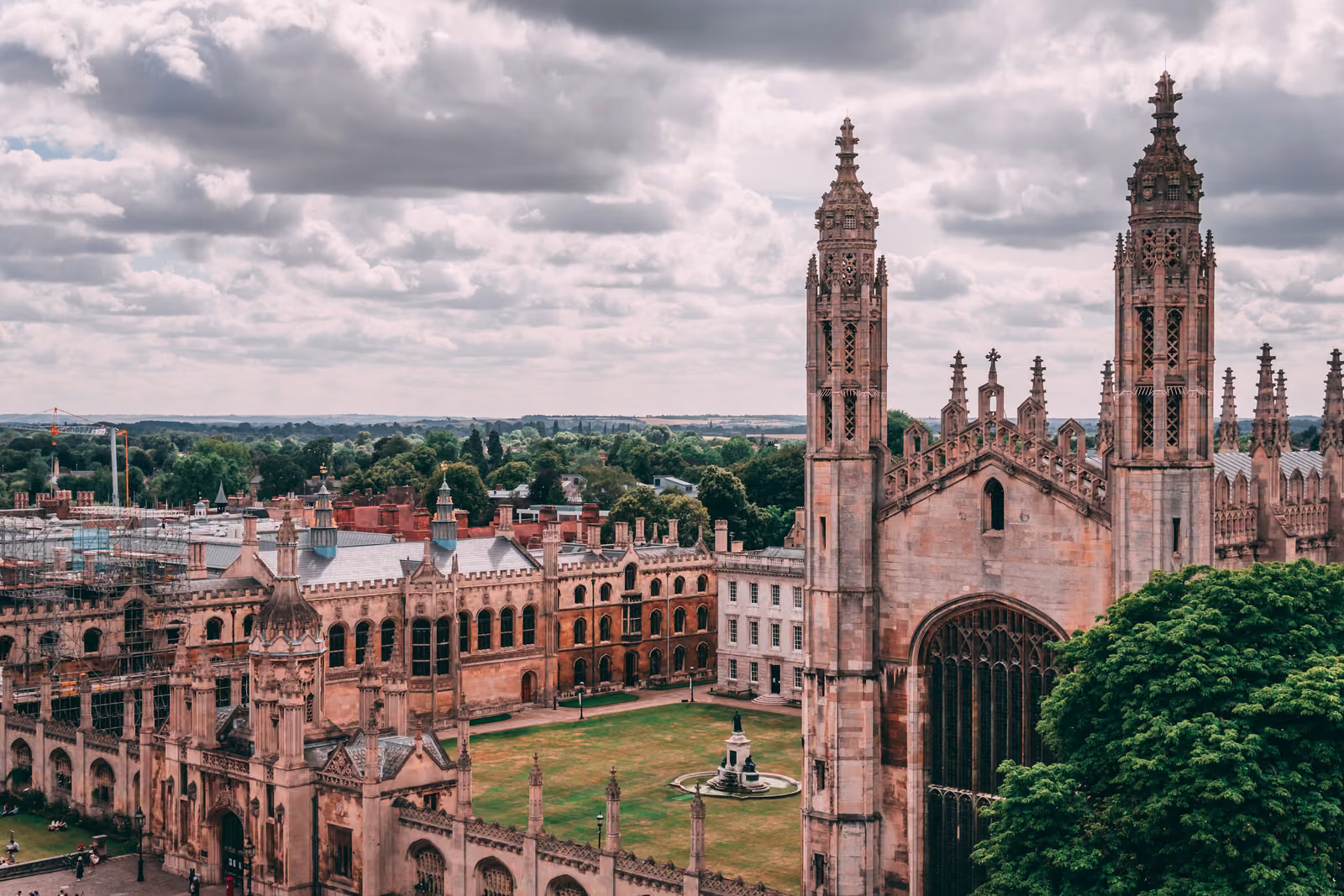
TL;DR: Cambridge has 29 colleges that admit undergraduates, and you apply to one of them. Your UCAS form is due 6pm on 15 October 2026, and Cambridge’s own extra form is due a week later on 22 October. Interviews run 7 to 18 December, and you find out on 27 January 2027.
Cambridge is one of the oldest and most selective universities in the world. Getting in takes more than excellent grades.
You will be working through a college system that exists nowhere else, sitting a subject test, and facing an interview built to test how you think rather than what you know.
This guide walks through what actually happens, from your UCAS form to your result.
What is the Cambridge application process?
You submit your UCAS application by 6pm UK time on 15 October, choosing either a specific college or an open application.
Then you complete Cambridge’s own form, called My Cambridge Application, due 22 October at 6pm. It asks for details UCAS does not cover.
Most courses need an admissions test, sat in mid-October. If you are shortlisted, you are interviewed in December.
Three rules catch people out:
- You cannot apply to Cambridge and Oxford in the same year. Decide early, because it changes your whole testing timeline.
- You can only submit one application to Cambridge per year. One course, one college.
- No school reference means no consideration. If your school does not submit one, your application is not assessed at all.
One more for 2027 entry. Cambridge will not download or review documents you upload to UCAS. Anything they need must come through My Cambridge Application or your college directly.
Full timeline: Cambridge application dates and deadlines.
How does the Cambridge college system work?
Twenty-nine Cambridge colleges admit undergraduates. Each works almost like a small university inside the bigger one.
Your college gives you accommodation, a dining hall, a library, and a community. Colleges also handle admissions and small-group teaching. Your lectures and your degree come from the university centrally.
So your college shapes your daily life. It does not change your degree.
If you do not mind which college you attend, you can make an open application. Pick campus code 9 on your UCAS form, and Cambridge allocates you to a college that has received fewer applications per place for your course. Open applicants are assessed exactly like direct applicants.
Two things to know first. You cannot transfer once allocated. And colleges differ in ways that matter: some have higher minimum offers, some make offers based on specific subjects, and accommodation and support vary. Interview format varies too, and you cannot be reallocated if you dislike the one you get.
Mature applicants aged 21 or over are allocated to Hughes Hall, St Edmund’s, or Wolfson.
Which admissions test do you need?
This depends entirely on your course. Some tests need advance registration. Some are arranged by your college after you are shortlisted. Some courses have no test at all.
| Test | Courses | Register in advance? |
|---|---|---|
| TMUA | Computer Science, Economics, Mathematics | Yes |
| ESAT | Chemical Engineering and Biotechnology, Engineering, Natural Sciences, Veterinary Medicine | Yes |
| UCAT | Medicine, Graduate Medicine | Yes |
| LNAT | Law | Yes |
| College assessment | Anglo-Saxon Norse and Celtic, Architecture, Asian and Middle Eastern Studies, Classics, Design, English, Geography, History, History and Modern Languages, History and Politics, HSPS, Linguistics, Linguistics and Modern Languages, Modern and Medieval Languages, Music, Philosophy, Psychological and Behavioural Sciences | No |
| No assessment | Archaeology, Education, Environment Law and Economics, History of Art, Theology Religion and Philosophy of Religion | Not applicable |
What the TMUA looks like. Two and a half hours in total, in two parts: Applications of Mathematical Knowledge, then Mathematical Reasoning. No calculator, no dictionary. There is no pass mark, and you do not lose marks for wrong answers, so answer everything. Cambridge says the test uses maths you have already learned at school and that you do not need a preparation course.
What the ESAT looks like. Computer-based, built from 40-minute multiple choice modules sat back to back. Mathematics 1 is compulsory for everyone. What comes next depends on your course:
- Chemical Engineering and Biotechnology, Natural Sciences, Veterinary Medicine: Mathematics 1 plus two modules you choose from Biology, Chemistry, Physics and Mathematics 2. That makes 120 minutes.
- Engineering: Mathematics 1 plus Physics and Mathematics 2. No choice here.
Same rules as TMUA. No pass mark, no negative marking.
Two things to watch. If you apply for Computer Science at Peterhouse or Trinity, you also sit the CSAT. And if you apply for Mathematics, you will sit STEP papers in May or June, after your offer.
Cost should not stop you. UK candidates in financial need can apply for a bursary voucher and sit either test free. Applications open 1 June 2026.
Full list: Cambridge admission tests.
What are the key dates for 2027 entry?
| Date | What happens |
|---|---|
| 1 June 2026 | Bursary and access arrangement applications open for ESAT and TMUA |
| 20 July 2026 | ESAT and TMUA booking opens |
| 1 August 2026 | LNAT booking opens |
| 1 September 2026 | You can submit your UCAS application |
| 14 September 2026 | ESAT and TMUA access arrangements deadline |
| 15 September 2026 | LNAT registration deadline |
| 16 September 2026 | UCAT registration deadline |
| 21 September 2026 | ESAT and TMUA bursary deadline |
| 24 September 2026 | Take the UCAT by this date |
| 28 September 2026 | ESAT and TMUA registration closes |
| 12–16 October 2026 | ESAT and TMUA test window |
| 15 October 2026, 6pm | UCAS deadline. Also the last day to sit the LNAT |
| 22 October 2026, 6pm | My Cambridge Application deadline |
| November 2026 | Interview invitations sent |
| 7–18 December 2026 | Main interview period |
| Mid to late January 2027 | Winter pool interviews |
| 27 January 2027 | You find out |
If you are in China, Hong Kong or Macau, your test dates are fixed. ESAT must be taken on 12 or 13 October. TMUA must be taken on 15 or 16 October. You do not get the full window.
Note that ESAT and TMUA registration closes on 28 September, more than two weeks before the UCAS deadline. Miss it and you cannot apply for those courses at all.
Mature applicants applying in the January round can sit either test from 4 to 8 January 2027, booking by 21 December 2026.
What happens at a Cambridge interview?
Cambridge calls these academic conversations, not interrogations. Every single person who receives an offer will have been interviewed.
Most applicants have one or two interviews, lasting 35 minutes to an hour in total. Some have three or four, depending on subject and college. The number says nothing about how strong your application is. Neither does when your invitation arrives.
You will usually talk with two or three interviewers. Expect to apply what you know to something new: a problem, a scenario, a piece of material you have not seen before.
If you apply for a science or maths course, expect to work through a problem and show your reasoning as you go. Some colleges send reading material in advance to discuss on the day.
You cannot reschedule. Keep the whole period free. Our guide to Oxbridge interviews covers how to prepare.
What to expect: Cambridge interviews.
Will your interview be online or in person?
Cambridge publishes this by college. It matters if you are applying from abroad.
| Format | Colleges |
|---|---|
| All online | Christ’s, Downing, Fitzwilliam, Girton, Hughes Hall, Lucy Cavendish, Magdalene, Murray Edwards, Newnham, Queens’, St Catharine’s, St Edmund’s, St John’s, Wolfson |
| All in person | Churchill, Emmanuel, King’s, Selwyn |
| Depends on where you live or your course | Clare, Corpus Christi, Gonville & Caius, Homerton, Jesus, Pembroke, Peterhouse, Robinson, Sidney Sussex, Trinity, Trinity Hall |
If you are applying from outside the UK, read this twice. Only four colleges require everyone to attend in person. Most colleges in the third group interview overseas applicants online, and Gonville & Caius, Pembroke and Trinity let you choose.
How does Cambridge decide who to admit?
Cambridge considers each application individually, using all of the following:
- your academic record
- your school or college reference
- your personal statement
- any submitted written work
- how well you do in your written admissions assessment
- contextual data and any extenuating circumstances
- your performance at interview, if you were interviewed
College Admissions Tutors weigh all of it together. Cambridge says it is most interested in your academic ability, shown through your most recent and relevant performance.
If a friend hears back before you, that means nothing. Colleges decide at different rates, and applicants to different colleges do not get updates at the same time.
What is the winter pool?
If your college likes your application but has no space, they can put it forward for other colleges to consider. That is the winter pool.
Cambridge publishes the numbers, and they are more encouraging than most people assume:
- Around 18% of applications received in October 2025 went into the winter pool.
- In January 2026, 1,060 pooled applicants received an offer from a different college. That is roughly 1 in 4 of everyone pooled.
- Only 20 applicants were invited to a second interview that January. Being pooled almost never means interviewing again.
You are not told in advance that you have been pooled. You find out one of three ways: an invitation to another interview, an offer from a college you did not apply to, or a rejection after the pool closes.
There are two other pools. A summer pool runs in August for offer holders who narrowly miss their conditions, and for applicants who apply for reconsideration. A spring pool runs for mature applicants who applied in January.
How decisions work: Cambridge application decisions.
Key Takeaways
- Twenty-nine Cambridge colleges admit undergraduates. Your college shapes your daily life, not your degree.
- You cannot apply to Cambridge and Oxford in the same year, and only one Cambridge application per year.
- No school reference means your application is not considered at all.
- Two deadlines, not one. UCAS on 15 October, My Cambridge Application on 22 October. Both 6pm UK time.
- ESAT and TMUA registration closes 28 September, before the UCAS deadline.
- Applicants from China, Hong Kong and Macau have fixed test dates inside the October window.
- Neither test has a pass mark and neither penalises wrong answers. Answer everything.
- UK candidates in financial need can sit either test free through a bursary voucher.
- Five courses need no admissions assessment at all.
- Interviews run 7 to 18 December. Most people have one or two, totalling 35 minutes to an hour.
- Only four colleges interview everyone in person.
- The winter pool is not a rejection. About 18% of applicants are pooled, and roughly 1 in 4 of those get an offer elsewhere.
- Decisions land on 27 January 2027.
Frequently Asked Questions
Can I apply to Oxford and Cambridge in the same year?
No. Cambridge states plainly that you cannot apply to both in the same year.
When will I find out if I got in?
If you applied in October and interviewed in December, you find out on 27 January 2027.
If I don’t get into my first-choice college, am I rejected?
Not necessarily. About 18% of October applicants go into the winter pool, and in January 2026, 1,060 of them received an offer from a different college.
Do I need a preparation course for the TMUA?
Cambridge says no. The test uses mathematics you have already covered at school. They recommend reading the test specification and the notes on logic and proof, and working through the free practice materials.
Do I need to prepare for an admissions test no matter what I’m applying for?
No. Only some courses need a test you register for in advance. Many use a college assessment arranged after shortlisting, and five courses have no assessment at all.
What is an open application?
You skip choosing a college and Cambridge allocates you to one with fewer applications per place. Open applicants are assessed the same way, but you cannot transfer once allocated.
Does research experience help a Cambridge application?
It gives you something real to defend when an interviewer asks you to apply your knowledge to something new, which is exactly what the interview tests. See how research programmes compare.
Conclusion
Getting into Cambridge takes more than strong grades. It takes understanding a process that runs on its own calendar, its own tests, and a college system that exists nowhere else.
Then it takes using every part of your application to show real depth in the subject you want to study.
If you want to build that depth before your application is due, OCAR pairs high school students with Oxbridge and Ivy League mentors for hands-on research. Learn more about what OCAR is.