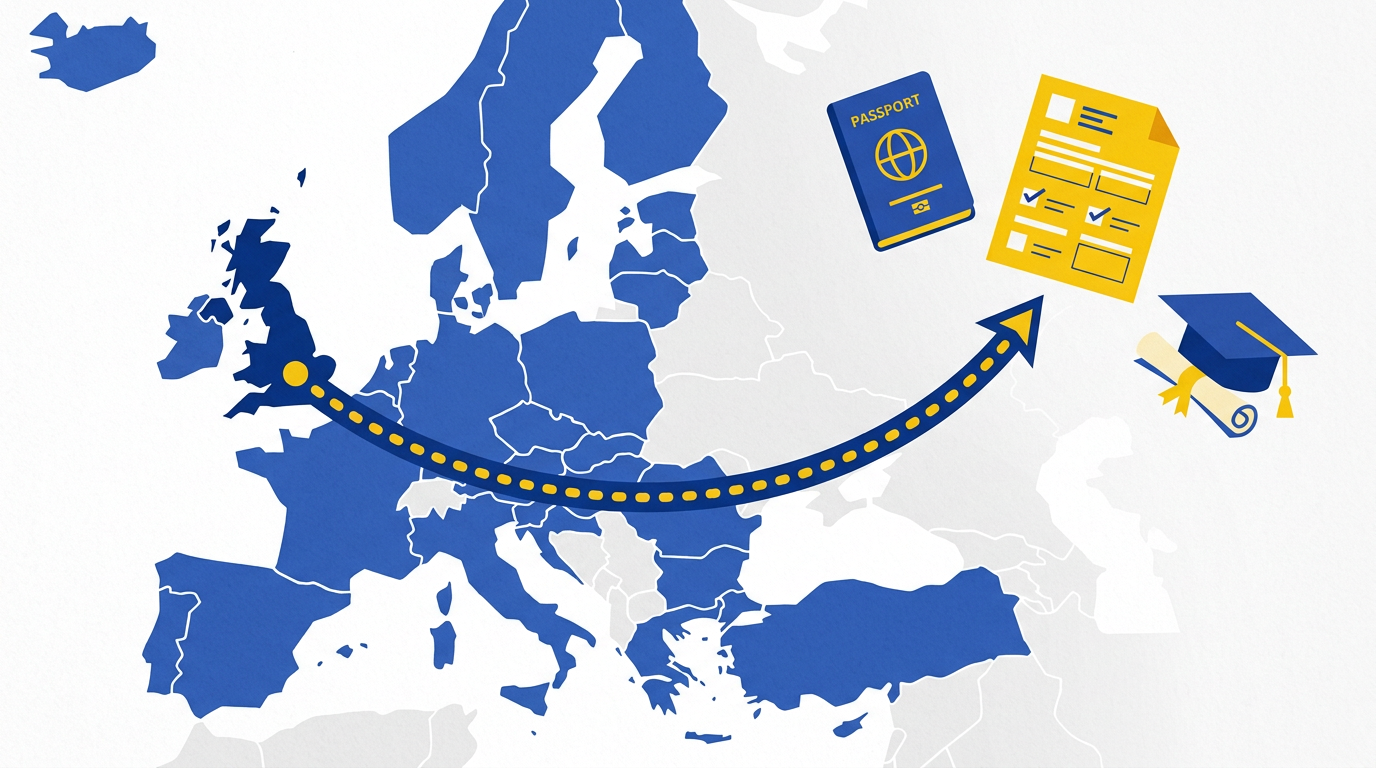
Three changes, each with its own date. From 1 January 2021 EU students generally need a Student visa. From 1 August 2021 student finance eligibility depends on citizens' rights rather than EU nationality. And most EU applicants now pay international rather than home fees. If you or a family member were living in the UK by 31 December 2020, different rules may apply to you.
Three things changed for EU applicants, each with its own date, and they are often discussed as one thing. They are not.
Everything below comes from UK government guidance for EU students. That page was last updated in March 2022 and several of its dates have passed, so confirm anything decision-critical with the university and with current guidance before relying on it.
Change 1: visas
From 1 January 2021, EU students generally need permission to study.
The guidance states you can apply for a Student visa if you are over 16 and plan to start a course with a licensed student sponsor. If you are 16 or 17 and studying at an independent school, "You may be eligible for a Child Student visa instead."
Two exceptions worth knowing:
- No visa is required for courses up to six months at an accredited institution.
- A Short-term study visa covers English language courses lasting up to 11 months.
Practically, this means a UK summer school of a few weeks does not need a Student visa, while a three-year degree does.
Change 2: student finance
From 1 August 2021, eligibility depends on citizens' rights rather than EU nationality.
For courses starting on or after that date, you are eligible for student finance if you have citizens' rights. Irish citizens are covered under the Common Travel Area arrangement.
Evidence requirements vary by status. Those with settled or pre-settled status generally need to show they have lived in the UK — or, for pre-settled status, in the listed EU, EEA and Swiss countries — for at least the last three years before the course starts.
Students in Scotland, Wales and Northern Ireland should contact the relevant funding body rather than assuming the England position applies.
Change 3: fee status
Most EU applicants now pay international rather than home fees.
This follows from the same citizens'-rights test that governs finance: home fee status rests on status and residence rather than on EU nationality. The government's eligibility rules for home fee status and student finance set out the detail.
One important procedural point: fee status is assessed by each university, against the regulations, usually through a fee status questionnaire after you apply. If your situation is borderline — recent residence, family connections, dual nationality — ask the university's admissions office directly rather than guessing from a forum.
The dates that matter
| Date | What turns on it |
|---|---|
| 31 December 2020 | Residence cut-off for EU Settlement Scheme eligibility |
| 1 January 2021 | Visa generally required for new students from this date |
| 30 June 2021 | Deadline for most Settlement Scheme applications |
| 1 August 2021 | Current student finance eligibility rules begin |
The Settlement Scheme is the one that still catches people out. You can apply after the deadline if you or a family member were living in the UK by 31 December 2020 and you either meet a criterion for a later deadline or have "reasonable grounds" for not applying in time. If you started a course from 1 January 2021 and were not living in the UK before 31 December 2020, you are not eligible to apply.
If anyone in your family was in the UK before that cut-off, it is worth checking properly. It changes both the fee and the finance answer.
What did not change
The academic side, entirely.
UCAS works the same way. Deadlines are the same — including the earlier October deadline for Oxford, Cambridge, medicine, dentistry and veterinary medicine. Personal statements, admissions tests, interviews and offer conditions are unchanged.
So the planning question is which universities are affordable, not how you present yourself to them. On the academic side, Caltech is one of very few universities anywhere that publishes a figure on research, reporting 42% of admitted students submitted some. Our guide for students applying to UK universities from abroad covers the supercurricular side, which is the part you control.
What is closed to you, and what is not
Worth saying plainly, because this is where EU applicants lose the most time.
Closed: almost all the free UK research schemes. UNIQ requires UK state school attendance. Nuffield Research Placements, In2scienceUK and Sutton Trust summer schools target under-represented UK backgrounds. These are widening-participation programmes funded to reach specific UK populations — the restriction is structural rather than about you.
Open, and free: self-directed research. Public datasets are international. IPUMS holds census microdata for dozens of countries, Eurostat covers the EU, World Bank and OECD data are cross-national by design. Our list of free datasets covers twenty-two sources and remote research opportunities covers the routes that need no travel at all.
Yale asks applicants to state "your specific contributions if the work was done in collaboration with others" — a question a solo researcher answers easily. There is a genuine advantage available here: a question about your own country, using your own country's data. You have access, context and language that nobody in the UK applicant pool has, and no programme sells it.
Also open: publishing. The International Journal of High School Research states that students "from any country may submit." Our comparison of student research venues covers the rest.
Three things worth doing
Resolve your fee status early. Contact the admissions office of one university you are serious about and ask how they would assess you. The answer usually generalises, and it determines whether your list is affordable.
Check the family angle. If anyone in your household was in the UK before 31 December 2020, find out whether a Settlement Scheme route exists. It is the single change with the largest financial consequence.
Budget for the visa properly. The application fee is not the whole cost — there is also the immigration health surcharge and evidence of funds. Finding this out in July is worse than finding it out now.
Where we fit
The Oxford Centre for Advanced Research runs 1:1 mentorships with PhD candidates and early-career researchers at Oxford, Cambridge, other leading UK universities and Ivy League institutions. The Oxford Scholar Programme is £2,000 — about $2,600 — for ten contact hours over ten to fourteen weeks. We accept approximately 60% of applicants: self-reported and unaudited.
We are not affiliated with the University of Oxford, and we are not immigration advisers. Nothing on this page is legal advice — it is a summary of published government guidance, and your university's admissions office is the authority on your fee status.
EU and international students are a large share of who we work with, for the reason set out above: the free UK routes are closed to them. That is an account of our market rather than a pitch. If your school has someone who can supervise a project, use them first.
The one thing to check this week
Whether anyone in your family was living in the UK before 31 December 2020.
It is a five-minute conversation and it is the only variable here that can change your fees by five figures a year.
Frequently asked questions
Do EU students need a visa to study in the UK?
Generally yes, for courses starting from 1 January 2021. Government guidance says you can apply for a Student visa if you are over 16 and starting a course with a licensed student sponsor, with a Child Student visa route for 16 and 17 year olds at independent schools. No visa is needed for courses up to six months at an accredited institution.
Do EU students pay home or international fees?
Most now pay international fees. Home fee status and student finance from 1 August 2021 depend on citizens' rights — broadly, settled or pre-settled status under the EU Settlement Scheme, or Irish citizenship under the Common Travel Area. Fee status is set by each university against the regulations, so confirm yours directly with them.
What is the EU Settlement Scheme deadline?
The deadline for most people was 30 June 2021. You can still apply if you or a family member were living in the UK by 31 December 2020 and you either meet a criterion for a later deadline or have reasonable grounds for the delay. If you were not living in the UK before 31 December 2020, you are not eligible.
Can EU students get student finance?
Only with citizens' rights. From 1 August 2021 eligibility rests on status rather than EU nationality. Those with settled or pre-settled status generally need to show three years' residence in the UK, or in the listed EU, EEA and Swiss countries for pre-settled status, before the course starts. Scotland, Wales and Northern Ireland have their own funding bodies.
Does any of this change how I should apply academically?
No. UCAS, deadlines, personal statements, admissions tests and interviews all work the same way. What changes is cost and immigration, which affects which universities are affordable rather than how you present yourself to them.
Are the free UK research programmes open to EU applicants?
Mostly not. UNIQ requires UK state school attendance, and Nuffield, In2scienceUK and Sutton Trust target under-represented UK backgrounds. They are widening-participation schemes funded to reach UK populations, so the restriction is structural rather than discriminatory.